Modeled positions
Compare recommended positions, alternatives, targets, and guardrails before choosing a path.
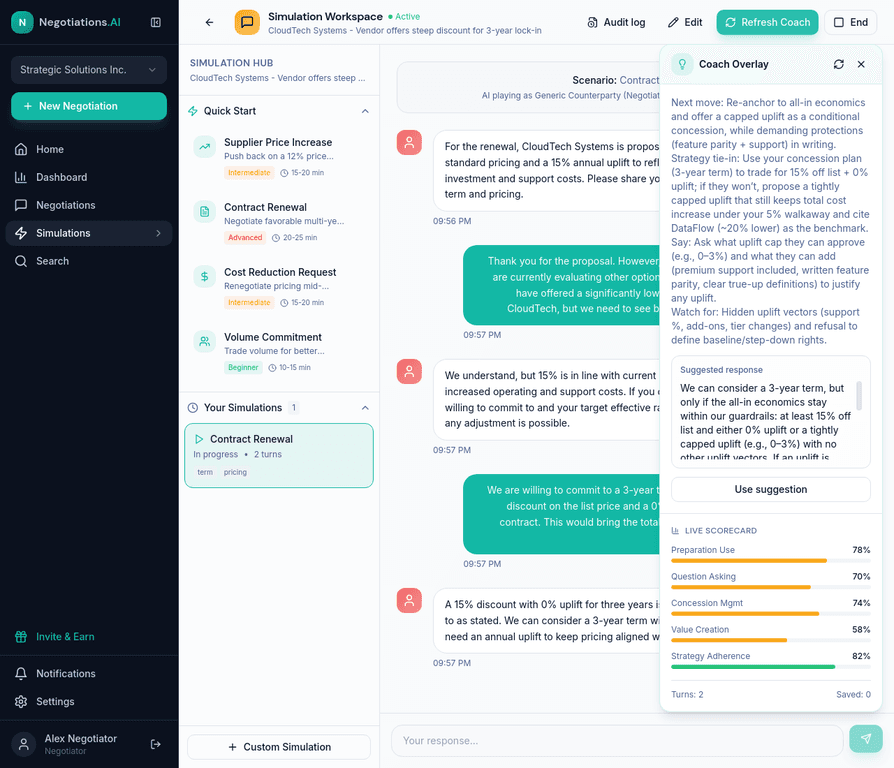
Negotiations.AI helps procurement teams compare possible moves, rehearse supplier responses, and choose a negotiation path before the room gets noisy.
Related category: AI negotiations workflow
Quick answer
Negotiation scenario modeling helps buyers compare possible paths before they negotiate: where to anchor, what to trade, what to hold, how a supplier might push back, and which fallback preserves the most value.
These examples show how the concept becomes visible inside a real negotiation workflow: intake, evidence, strategy, tactics, simulation, and learning.
Compare recommended positions, alternatives, targets, and guardrails before choosing a path.
Translate scenarios into give/get trades and supplier-response options.
Practice supplier pushback and receive next-move coaching before the meeting.
Strategy brief
Northstar Packaging renewal
Recommended position
Keep Northstar in the award mix, but make delivered-cost parity the commercial anchor before any share commitment.
Our current position
Apex has credible alternatives, but qualification timing and continuity risks mean the final ask needs clear fallback paths.
Targets aligned to objectives
MDO / LAA60-day payment terms
Alternative path if the primary position stalls.
Phased share commitment
Alternative path if the primary position stalls.
Supplier-funded tooling
Alternative path if the primary position stalls.
Procurement teams often walk into supplier meetings with a target number but no modeled path. Negotiations.AI turns the plan into scenarios so teams can review assumptions, rehearse objections, and avoid accidental concessions.
Clarifies the range, alternatives, and walk-away logic before concessions begin.
Models price, volume, term, payment timing, scope, SLA, implementation, and risk as connected levers.
Simulates supplier pushback and gives teams language they can use in live conversations.
Use scenarios to make strategy review concrete enough for stakeholders and buyers.
Define target, acceptable, and walk-away positions for each issue that could become a trade.
Separate known evidence from guesses about supplier cost, capacity, urgency, and constraints.
Build multiple equivalent offers and fallback paths instead of relying on one ask.
Practice supplier objections around price, deadline, approval authority, risk, and scope.
Choose the opening, questions, and concession guardrails that fit the evidence.
Scenario modeling is most valuable when there is no single right answer and the supplier can move the conversation.
Test whether to challenge the cost basis, trade volume, adjust index terms, or phase the increase.
Compare term length, license count, ramp, service credits, data rights, and exit flexibility.
Prepare paths for suppliers that can influence continuity, roadmap, capacity, or stakeholder confidence.
Better AI negotiation outputs start with the same thing stronger human negotiators use: clear facts, explicit constraints, and a disciplined view of leverage.
Issue ranges
Target, acceptable, and walk-away positions for every issue the buyer may trade.
Supplier hypotheses
What the supplier may value: volume, cash timing, certainty, references, capacity smoothing, or risk reduction.
Decision constraints
Finance, legal, security, operations, and executive guardrails that limit possible concessions.
Fallback paths
Alternatives, escalation routes, switching paths, and phased options that preserve leverage.
Learn how AI-assisted prep turns prompts into a controlled process.
See how Negotiations.AI supports practice before the supplier meeting.
Turn modeled scenarios into approval-ready decisions.
A practical guide for modeling supplier negotiation paths.
Clarify alternatives, agreement range, walk-away logic, and trade package strategy.
Plan concessions as give/get trades instead of one-sided movement.
Concepts that help buyers reason about supplier moves.
It is the process of testing possible negotiation paths before a live conversation, including anchors, concessions, supplier pushback, fallback options, and decision trade-offs.
Scenario modeling makes BATNA and ZOPA practical by showing what the team should do if the supplier accepts, rejects, counters, delays, or reframes the ask.
It overlaps with training, but the purpose is deal execution. The scenarios are tied to a real supplier, real constraints, and a real decision.
AI can draft scenarios and likely pushback, but the team should validate assumptions against evidence and approvals before using them.
Start with a real negotiation, add the facts you trust, and pressure-test the plan before the supplier meeting.