Evidence review
Separate facts, assumptions, gaps, conflicts, and analyses before generating a recommendation.
AI can support intake, spend analysis, supplier research, sourcing, contracts, negotiation, and governance. The durable value comes from connecting those capabilities to trusted evidence, accountable decisions, and human approval.
Related category: AI risk in the commercial supply chain
Quick answer
AI procurement is the use of machine learning and generative AI to help buying teams analyze spend, research suppliers, prepare sourcing events, review commercial terms, plan negotiations, and document decisions. Strong implementations keep humans accountable for supplier selection, concessions, commitments, and approvals.
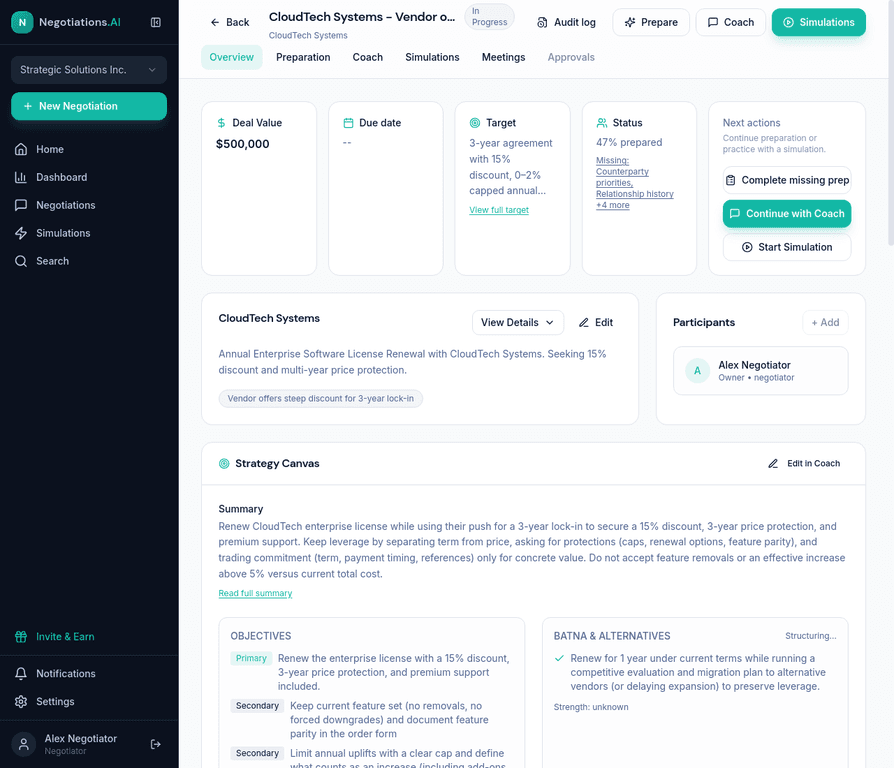
These examples show how the concept becomes visible inside a real negotiation workflow: intake, evidence, strategy, tactics, simulation, and learning.
Separate facts, assumptions, gaps, conflicts, and analyses before generating a recommendation.
Compare positions, alternatives, leverage, trade-offs, risks, and approval requirements.
Turn approved ranges into trade packages, supplier questions, talk tracks, and escalation paths.
Preserve outcomes, supplier behavior, decision rationale, and reusable playbooks.
Fact base
Northstar Packaging renewal
Completed analyses
10 readyRevenue comparison across packaging suppliers
Scope: this negotiation · Updated today
Term variation dollar impact analysis
Scope: this negotiation · Updated today
Cost-driver index and freight sensitivity
Scope: this negotiation · Updated today
Supplier profile and risk scan
Scope: this negotiation · Updated today
Gaps
Receiving-plant freight matrix still missing.
Conflicts
Two payment-term sources disagree.
Assumptions
Index exposure estimated from 8 SKU families.
AI procurement is not one feature. It spans analytics, workflow assistance, decision support, and controlled automation. Teams should evaluate each use case by the quality of its evidence, the consequence of a wrong answer, and the point where a human must approve the next action.
Connect recommendations to contracts, spend, supplier history, benchmarks, market signals, and explicit stakeholder constraints.
Turn analysis into comparable options, trade-offs, negotiation ranges, risks, and approval-ready recommendations.
Keep buyers and approvers responsible for supplier-facing commitments, exceptions, concessions, and final decisions.
Start with bounded, reviewable decisions and expand only after the team can measure evidence quality, adoption, and business outcomes.
Define the buying decision, user, required evidence, business risk, and approval owner before selecting a model or tool.
Map contracts, spend, supplier records, performance history, policies, and external signals to the use case.
Require structured findings, assumptions, missing evidence, confidence, options, and recommended next steps.
Set approval gates, role permissions, escalation rules, audit history, and restrictions on supplier-facing actions.
Track cycle time, adoption, decision quality, savings, risk, supplier outcomes, and reusable organizational learning.
Use this model to compare products by the job they perform and the amount of supplier-facing authority they receive.
| Category | Primary job | Human role | Best fit |
|---|---|---|---|
| Procurement analytics AI | Classify spend, detect patterns, and identify opportunities | Validate data and choose which opportunities to pursue | Spend visibility, forecasting, price variance, and opportunity pipelines |
| Procurement copilot | Draft, summarize, research, and prepare reviewable work | Review evidence, edit outputs, and approve next actions | Intake, research, requirements, proposal analysis, and documentation |
| Negotiation intelligence | Model leverage, ranges, trade packages, and supplier responses | Own strategy, concessions, relationships, and commitments | Strategic supplier negotiations, renewals, price increases, and SLAs |
| Autonomous procurement agent | Execute bounded workflow or supplier interactions within policy | Set authority, policies, exceptions, monitoring, and escalation | Repeatable, lower-risk workflows with explicit guardrails |
Negotiations.AI research team
Procurement negotiation product and research review
Reviewed 2026-07-11
The category model separates analytical, assistive, decision-support, and autonomous use cases by evidence requirements, consequence of error, supplier-facing authority, and human approval. It is maintained as product capabilities and public guidance evolve.
The right operating model differs by use case. Analysis and preparation can tolerate drafting; supplier commitments require tighter control.
Classify spend, identify price variance, surface consolidation opportunities, and turn findings into supplier-specific questions.
Organize supplier capabilities, performance, risk, alternatives, benchmarks, and market changes around a buying decision.
Draft requirements, compare proposals, identify commercial differences, and prepare reviewable negotiation issues.
Build fact bases, BATNA and ZOPA ranges, trade packages, talk tracks, role-play scenarios, and approval briefs.
Better AI negotiation outputs start with the same thing stronger human negotiators use: clear facts, explicit constraints, and a disciplined view of leverage.
Internal commercial data
Contracts, purchase orders, invoices, price history, volume, usage, service levels, and prior concessions.
Supplier context
Performance, risk, meeting history, relationship constraints, capacity, financial signals, and available alternatives.
External market evidence
Benchmarks, indices, public filings, credible quotes, market research, regulatory changes, and category signals.
Governance context
Policies, approval thresholds, legal and security requirements, stakeholder constraints, and audit obligations.
Read the leadership paper on embedded AI risk across supplier relationships.
Follow the full lifecycle from demand definition through supplier management and learning.
Download the measurement template for adoption, evidence quality, governance, and value.
Use the machine-readable Search Console, Clarity citation, and bot-activity baseline.
See how an AI copilot supports supplier negotiation preparation.
Explore evidence-grounded, human-led negotiation intelligence.
Connect internal and external evidence to procurement decisions.
Turn spend findings into supplier questions and negotiation action.
Compare human-led, autonomous, sourcing, and contract use cases.
Apply human control, data quality, and governance to negotiation AI.
AI procurement applies machine learning and generative AI to procurement analysis, sourcing, supplier management, contracts, negotiation, workflow, and decision support.
Automation follows defined rules to complete work. AI can classify, infer, generate, compare, or recommend, which creates additional evidence, review, and governance requirements.
AI can prepare humans for negotiations or conduct bounded supplier interactions. Supplier-facing autonomy should be limited by explicit authority, guardrails, approvals, monitoring, and escalation rules.
Evaluate evidence quality, workflow fit, measurable outcomes, security, permissions, auditability, integration effort, human approval, and the cost of an incorrect recommendation or action.
Begin with a bounded, high-frequency decision where trusted inputs exist, a human can review the output, and cycle time or decision quality can be measured.
Start with a real negotiation, add the facts you trust, and pressure-test the plan before the supplier meeting.