Leadership Paper 4
AI in the Commercial Supply Chain
How AI Is Changing the Risk Profile of Complex Commercial Decisions
A procurement leadership paper on identifying and governing AI risk embedded in software, equipment, services, and supplier operations.
Executive summary
Artificial intelligence is rapidly becoming embedded across the products, equipment, services, and supplier relationships organizations rely on every day. This changes the procurement challenge.
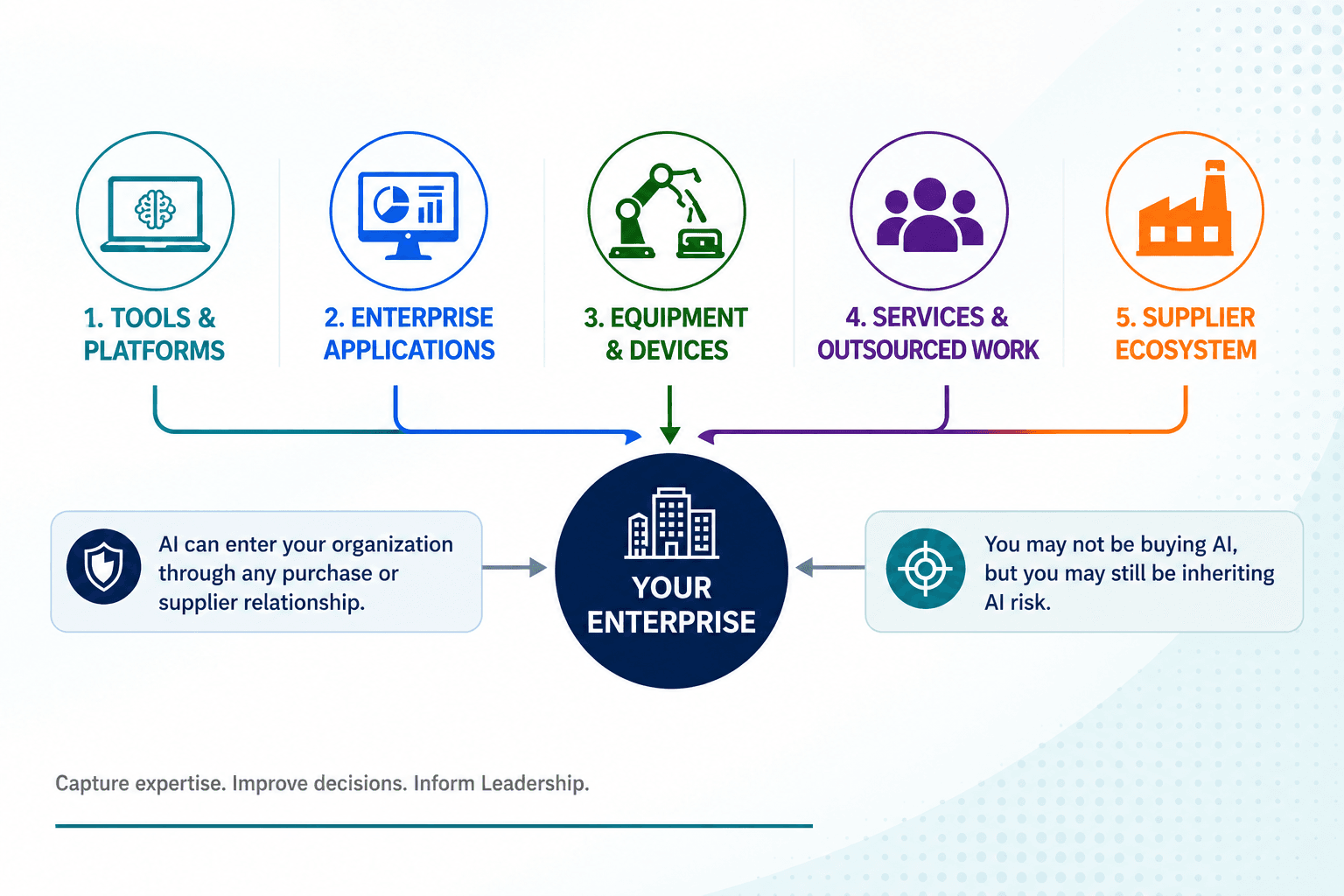
Organizations no longer encounter AI only when they intentionally purchase an AI platform. AI may be embedded in enterprise software, incorporated into industrial equipment, used by consultants to produce analyses, applied by engineering firms to develop designs, or used at some point within a supplier’s process to create a product or service.
You don’t have to buy an AI product to inherit AI risk.
For procurement leaders, this creates a new commercial responsibility. Complex negotiations increasingly require organizations to understand not only price, service, performance, and traditional contractual terms, but also how AI may affect intellectual property, confidential information, data, accountability, compliance, cybersecurity, liability, and governance.
Leading organizations will identify AI-related considerations earlier, incorporate them into commercial strategy, negotiate appropriate protections, and preserve what they learn for future decisions.
AI is expanding the commercial risk surface. Procurement needs a repeatable way to manage it.
Key takeaway for procurement leaders
You don’t have to buy an AI product to inherit AI risk. Procurement leaders need a repeatable commercial discipline that identifies AI early, aligns the right stakeholders, negotiates appropriate protections, governs the resulting obligations, and preserves what the organization learns.
1. AI Is Becoming Part of What Organizations Already Buy
For procurement leaders, the more important AI development may be how quickly it is becoming embedded within existing spend categories.
- Tools and platforms — foundational models, development environments, copilots, analytics tools, and specialized AI applications.
- Enterprise applications — procurement, supply chain, finance, legal, HR, engineering, customer service, and other business software are increasingly incorporating AI capabilities.
- Equipment and physical systems — manufacturing equipment, robotics, medical devices, industrial systems, vehicles, and other products incorporating AI-enabled functionality.
- Services and outsourced work — consultants, engineering firms, law firms, software developers, service providers, and other suppliers are increasingly using AI to produce work on behalf of their clients.
The procurement implication is significant.
AI is becoming less of a discrete buying category and more of a characteristic of complex commercial purchases.
A sourcing team may encounter AI even when the business requirement never began as an “AI project.” It is increasingly touching data, decisions, and operations across supplier relationships.
2. AI Risk Doesn’t Stop at Your Enterprise
Most organizations naturally focus first on the AI technologies their own employees use. That captures only part of the exposure.
Internal AI Supply Chain
These are AI capabilities the organization knowingly purchases or deploys: software, platforms, applications, equipment, and other AI-enabled technologies. Organizations can evaluate these purchases directly and establish requirements for how the technology will be used.
External AI Supply Chain
The second supply chain is less visible. Suppliers may use AI to create the products, services, recommendations, analysis, software, designs, documents, components, or other deliverables that the enterprise purchases.
A consulting firm may use AI to develop an analysis. An engineering supplier may use it to create a design. A software developer may use AI-generated code. A manufacturer may incorporate AI-enabled components or systems. A professional services provider may use AI to generate recommendations.
Every supplier using AI can potentially become part of your organization’s AI risk profile.
The relevant question is increasingly not simply “Are we buying AI?” It is: “Where is AI being used in the products, services, and outcomes we are buying?”
3. The Commercial Questions Are Changing
AI does not eliminate traditional procurement considerations. Price, service, supplier performance, commercial terms, implementation, and business value remain critical. But complex purchases can now introduce additional questions.
- Who owns intellectual property created with AI?
- Can company information be used to train a supplier’s models?
- What confidential information can enter an AI system?
- Must a supplier disclose its use of AI?
- How are AI-generated outputs tested and validated?
- Who is accountable when an AI-generated recommendation or deliverable is incorrect?
- What happens when the underlying model or technology changes?
- What audit, monitoring, cybersecurity, regulatory, or compliance requirements apply?
- How should liability and indemnification be addressed?
These are commercial questions that can influence supplier selection, negotiation strategy, contractual protections, governance, and ultimately the business decision.
Their importance increases when AI is embedded within high-value, strategically important, or operationally critical purchases.
4. Governance Must Move Earlier
The greatest risk may not be that organizations fail to recognize AI-related requirements. It may be that they recognize them too late.
A business stakeholder identifies a solution. The supplier is evaluated. Commercial discussions progress. Pricing is negotiated. Momentum builds toward an award. Then Legal, Technology, Cybersecurity, Risk, or another stakeholder discovers an unresolved AI-related requirement.
The procurement process appears to have created the delay. But the underlying issue began much earlier.
Late-stage procurement emergencies often begin as early-stage planning gaps.
AI makes this more consequential because the questions can involve intellectual property, confidential data, regulation, cybersecurity, liability, and business continuity.
Leading organizations, therefore, need to move governance upstream. AI-related questions should begin when the business requirement is being defined and continue through supplier evaluation, negotiation, contracting, implementation, and ongoing supplier management.
The objective is not more governance. The objective is earlier governance, so necessary controls do not become unnecessary delays later.
5. From AI Awareness to Commercial Discipline
Managing this environment requires more than maintaining a list of AI clauses. Organizations need a repeatable commercial discipline.
- Identify. Determine where AI exists within the proposed product, service, supplier process, or deliverable.
- Understand. Establish how AI will be used and what data, intellectual property, systems, decisions, or business outcomes may be affected.
- Align. Bring Procurement, Business, Legal, Technology, Risk, Finance, Operations, and other necessary stakeholders into the decision early enough to influence it.
- Negotiate. Translate requirements into commercial positions, responsibilities, protections, and appropriate contractual language.
- Govern. Preserve the decisions, obligations, approvals, rationale, and negotiated protections so they can be monitored and reused.
- Learn. Capture what worked, what created risk, which supplier positions were accepted, and how requirements should evolve for future negotiations.
This is where the lessons from the earlier papers become increasingly important. AI creates more decisions to make, more knowledge to preserve, more expertise to scale, and more stakeholders to align.
6. Questions Every Procurement Leader Should Ask
- Do we know where AI is entering our organization through suppliers — not just through the AI tools we purchase directly?
- Are AI-related commercial, IP, legal, technology, and risk requirements identified before supplier negotiations are substantially complete?
- Can our buyers recognize when a purchase requires additional AI-related review?
- Are negotiated AI protections and supplier positions captured so the next team can reuse what the organization has learned?
- As AI becomes embedded across more spend categories, can our current process scale without creating additional bottlenecks?
The challenge is not managing one sophisticated AI negotiation.
It is managing hundreds of commercial relationships that increasingly contain some element of AI.
7. The Negotiations.AI Perspective
AI is increasing commercial complexity, but the procurement challenge remains familiar: organizations need the right information, expertise, stakeholder input, and governance when making important decisions.
Negotiations.AI is designed to help organizations bring that intelligence into the commercial process earlier.
By capturing institutional knowledge, guiding preparation, surfacing relevant considerations, and preserving commercial decisions and outcomes, organizations can create a more repeatable approach to complex negotiations — including those involving AI.
The goal is not to create a separate procurement process for every emerging technology. It is to build a commercial decision capability that can adapt as technologies, risks, suppliers, and business requirements change.