Leadership Paper 1
Institutional Procurement Knowledge
The Missing Strategic Asset in Modern Procurement
A procurement leadership paper on capturing negotiation strategy, supplier behavior, commercial rationale, and institutional knowledge as an enterprise asset.
Executive summary
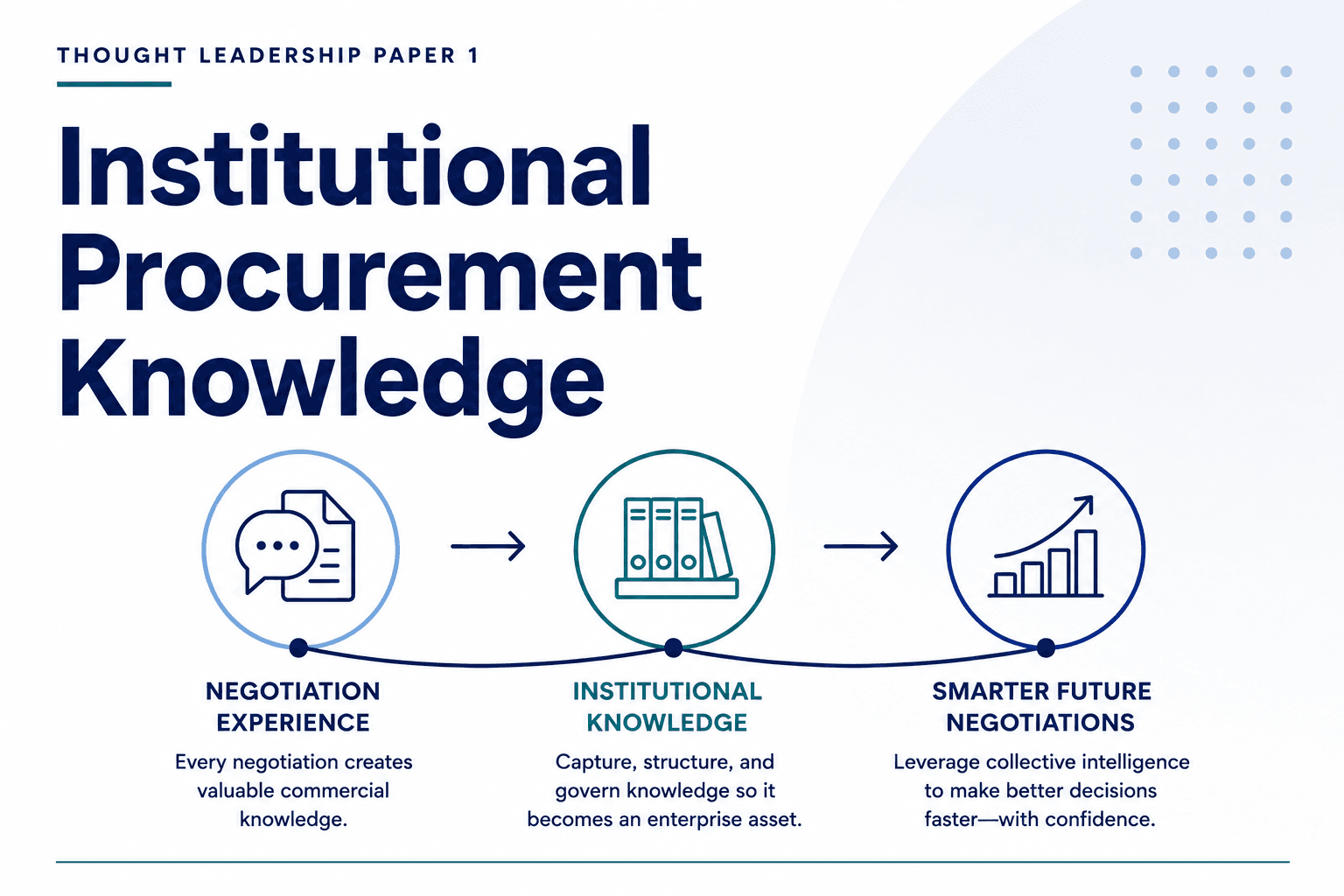
Procurement organizations have invested billions in systems that automate sourcing, contracts, supplier management, and purchasing. These platforms have transformed execution, yet one strategic asset remains largely unmanaged: the commercial knowledge created through every negotiation.
As procurement becomes more strategic, organizations risk losing the context behind their most important commercial decisions. This paper introduces Institutional Procurement Knowledge as a framework for capturing, preserving, governing, and continuously improving that knowledge.
Key takeaway for procurement leaders
Every negotiation should leave the organization smarter. Procurement leaders can turn the commercial reasoning created throughout sourcing and negotiation into a governed enterprise asset that compounds in value over time.
1. The Organizational Knowledge Gap
Modern procurement teams are expected to deliver savings, manage supplier risk, support innovation, evaluate AI-enabled solutions, align stakeholders, and negotiate increasingly complex commercial agreements. However, while enterprise systems capture transactions and documents, they rarely preserve the commercial reasoning behind key decisions.
Negotiation strategy, supplier behavior, stakeholder dynamics, and the rationale for trade-offs often remain in emails, spreadsheets, meeting notes, or individual experience. Traditionally, the approach to managing information has worked, but today’s complexity outpaces an individual’s ability to pass along expertise.
2. Beyond Traditional Knowledge Management
Institutional Procurement Knowledge is not another document repository. Traditional knowledge management focuses on policies, training materials, and lessons learned. Institutional Procurement Knowledge captures the commercial intelligence that drives better procurement decisions.
That knowledge includes:
- Negotiation strategy
- Stakeholder alignment
- Supplier behavior
- Commercial rationale
- Pricing history
- Concessions and trade-offs
- BATNA development
- Executive decisions
- Governance considerations
- AI evaluations
- Why decisions were made
3. A New Strategic Capability
Institutional Procurement Knowledge is an organization’s ability to systematically capture, preserve, govern, and continuously improve the commercial intelligence created throughout sourcing and negotiation. It transforms individual expertise into an enterprise asset that compounds in value over time.
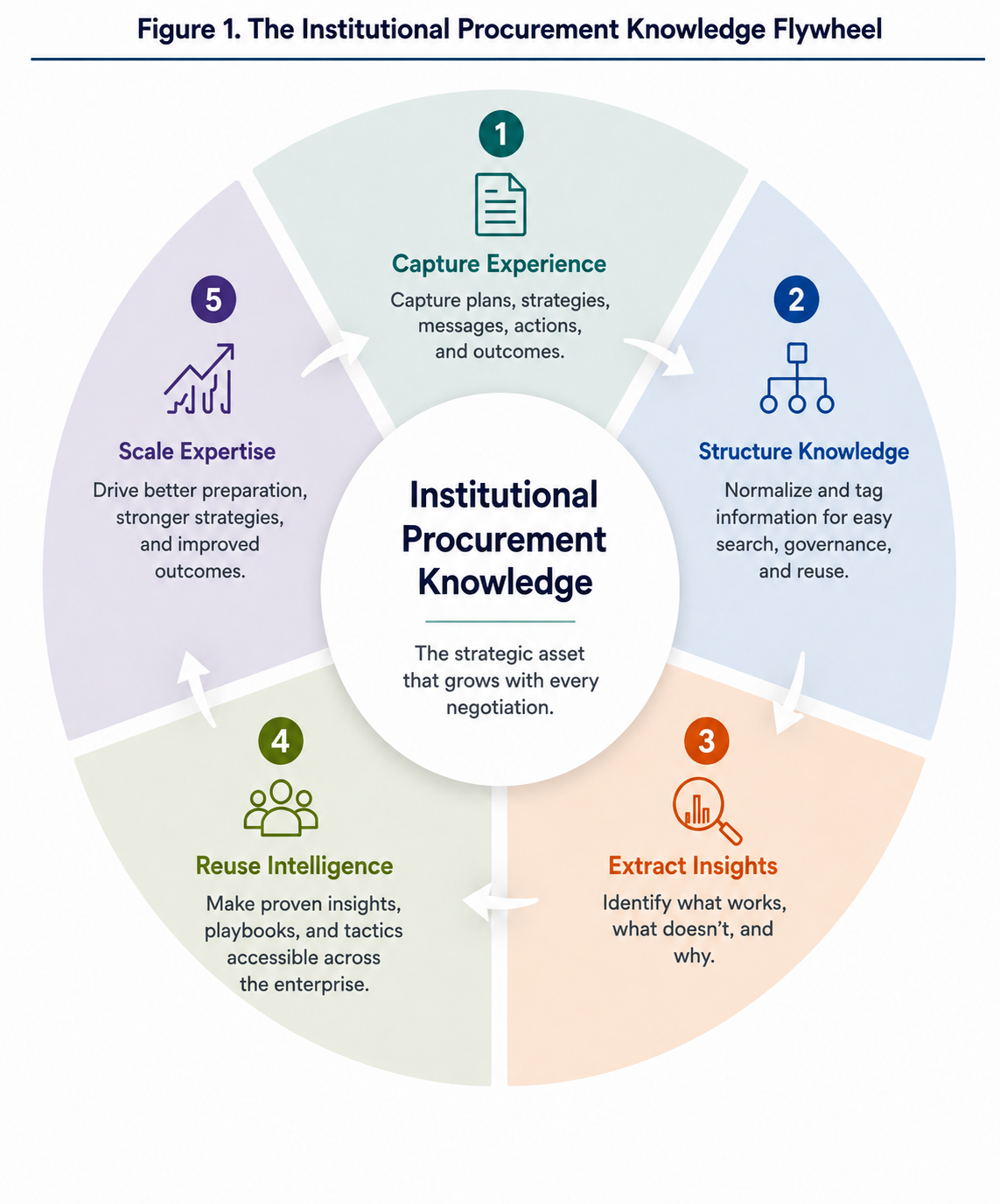
4. The Institutional Procurement Knowledge Flywheel
Every sourcing event should strengthen the organization’s commercial capability rather than ending as an isolated transaction. Every negotiation creates knowledge that can be captured, structured, reused, and scaled.
5. A New Enterprise Asset
Every Enterprise Platform Preserves Organizational Memory
- ERP preserves financial memory.
- CRM preserves customer memory.
- PLM preserves product memory.
- HRIS preserves employee memory.
Procurement has historically lacked an equivalent system for commercial memory. Institutional Procurement Knowledge fills that gap.
6. Questions Every Procurement Leader Should Ask
- How much negotiation knowledge leaves when experienced employees retire or change roles?
- Can new category managers quickly benefit from previous negotiations?
- Does your organization consistently capture why supplier decisions were made?
- Can commercial knowledge be governed and reused across categories and business units?
7. The Negotiations.AI Perspective
Negotiations.AI is built on a simple principle: every negotiation should leave the organization smarter than it was before. The platform captures commercial context, negotiation strategy, stakeholder decisions, and outcomes so organizations continuously build Institutional Procurement Knowledge.
Rather than replacing existing procurement platforms, it complements them by protecting and expanding this strategic enterprise asset.