Evidence-led
Separate facts, assumptions, estimates, and missing information before setting positions.
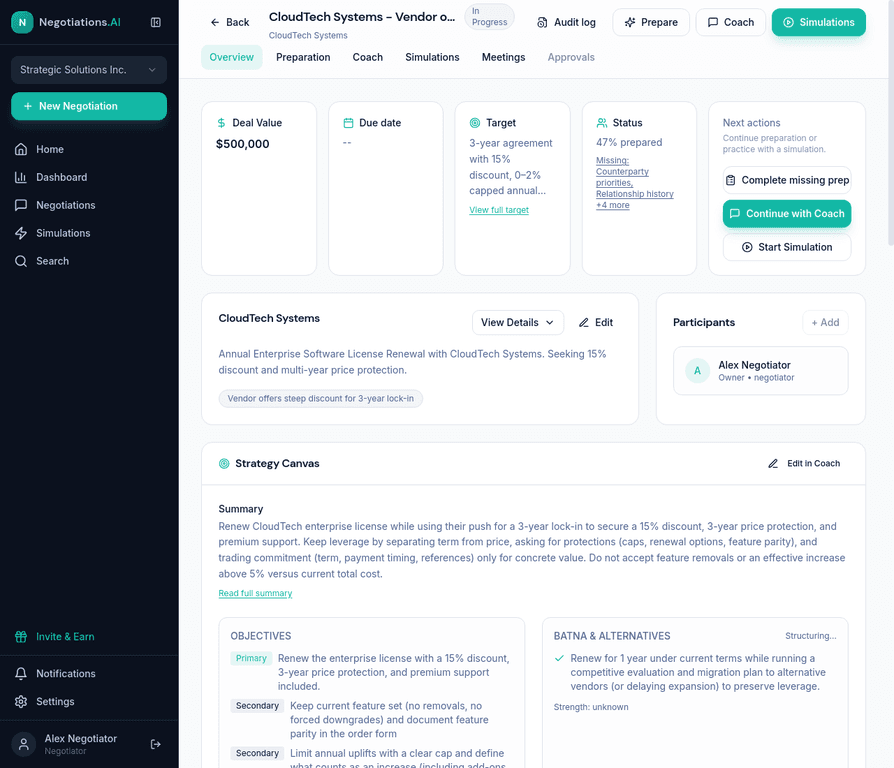
A negotiation plan connects evidence, objectives, alternatives, leverage, trade packages, questions, guardrails, and decision authority before the conversation begins.
Related category: Negotiation scenario modeling
Quick answer
Negotiation planning is the structured process of deciding what the team wants, what evidence supports its position, which alternatives are executable, what can be traded, and who may approve a change. The result is a concise plan that guides the negotiator without replacing judgment during the conversation.
Good planning makes assumptions visible and converts broad goals into ranges, priorities, questions, packages, concession rules, and escalation points. It leaves room for discovery while protecting the decisions that must not be improvised.
Separate facts, assumptions, estimates, and missing information before setting positions.
Prepare conditional exchanges and packages rather than negotiating one issue at a time.
Document authority, walk-away rules, and escalation paths before time pressure arrives.
The sequence keeps analysis tied to decisions the negotiating team can execute.
Set targets, priorities, constraints, measures of success, and unresolved stakeholder choices.
Assemble commercial history, contracts, performance, benchmarks, market evidence, and counterparty context.
Validate BATNA, estimate the ZOPA, and document uncertainty instead of treating estimates as facts.
Prioritize issues, create trade packages, plan diagnostic questions, and set concession conditions.
Red-team the plan, assign roles, approve guardrails, and define escalation triggers.
Avoid forcing every planning decision into one overloaded document.
| Category | Primary job | Human role | Best fit |
|---|---|---|---|
| Fact base | Organize evidence and uncertainty | Validate relevance and reliability | Claims, benchmarks, history, and market context |
| Strategy canvas | Connect objectives, leverage, alternatives, and ranges | Choose positions and trade-offs | Team alignment and approval |
| Scenario model | Test offers and counterparty responses | Interpret assumptions and select responses | Uncertain or multi-issue negotiations |
| Meeting brief | Make the approved plan usable live | Adapt to new information | Questions, roles, guardrails, and next moves |
The model separates evidence, assumptions, choices, supplier-facing moves, and approval authority. Supporting articles test each component against common procurement situations and link back to this canonical planning guide.
Use a proportionate plan whenever value, complexity, risk, or stakeholder disagreement makes improvisation costly.
Test the cost claim, isolate drivers, prepare questions, and define conditional responses.
Use deadlines, utilization, service performance, alternatives, and switching readiness to create leverage.
Develop non-switching alternatives across scope, timing, demand, risk, governance, and future commitments.
Resolve internal priorities and approval authority before the counterparty can exploit misalignment.
Better AI negotiation outputs start with the same thing stronger human negotiators use: clear facts, explicit constraints, and a disciplined view of leverage.
Objectives and constraints
Targets, priorities, budgets, deadlines, policies, dependencies, and decision owners.
Alternatives and leverage
Executable BATNAs, switching cost, timing, dependency, capacity, and information advantages.
Issue economics
Price, total cost, service, risk, volume, term, specification, and implementation trade-offs.
Authority and guardrails
Approval limits, walk-away rules, concession conditions, legal constraints, and escalation routes.
Model BATNA, ZOPA, offer packages, and response scenarios.
Build the evidence and leverage signals that inform the plan.
Carry approved questions, targets, and guardrails into the meeting.
Understand the two ranges at the center of a negotiation plan.
Review the essential preparation decisions before a meeting.
Include objectives, priorities, evidence, assumptions, BATNA, ZOPA estimate, leverage, questions, issue trades, concession rules, roles, approvals, risks, and follow-up responsibilities.
Preparation collects information and organizes the meeting. Planning converts that information into choices, ranges, trade packages, guardrails, and accountable decision rights.
Software can organize evidence, expose gaps, model scenarios, and draft options. Humans remain responsible for relationships, risk judgments, approval, and supplier-facing commitments.
Approve material targets, walk-away rules, concession authority, contractual risk, and escalation routes before the live negotiation begins.
Start with a real negotiation, add the facts you trust, and pressure-test the plan before the supplier meeting.