Leadership Paper 3
Commercial Decision Intelligence
How Leading Procurement Organizations Make Better Decisions as Complexity Increases
A procurement leadership paper on aligning finance, legal, technology, operations, risk, and business priorities before commercial decisions.
Executive summary
Procurement decisions are becoming more complex. A sourcing or negotiation decision that once centered primarily on price, service, and supplier capability may now require procurement leaders to balance financial objectives, business requirements, technology considerations, operational impacts, contractual obligations, governance, and risk.
More information should lead to better decisions. But often it creates the opposite problem. Critical information sits across stakeholders, documents, systems, market research, supplier proposals, previous negotiations, and individual experience.
Procurement is increasingly responsible for bringing these perspectives together before a commercial commitment is made. This paper introduces Commercial Decision Intelligence: the organizational capability to bring the right information, expertise, and stakeholder perspectives together to make better commercial decisions.
Key takeaway for procurement leaders
Late-stage procurement emergencies often begin as early-stage planning gaps. Procurement leaders can improve decision quality by bringing market intelligence, institutional knowledge, stakeholder priorities, alternatives, risk, and negotiation strategy together before a commercial commitment is made.
1. The Commercial Decision Has Changed
Procurement historically optimized around relatively understandable dimensions: price, service, terms, and supplier performance. Those dimensions still matter, but today’s strategic negotiations increasingly sit at the intersection of business, finance, technology, legal, risk, and operations.
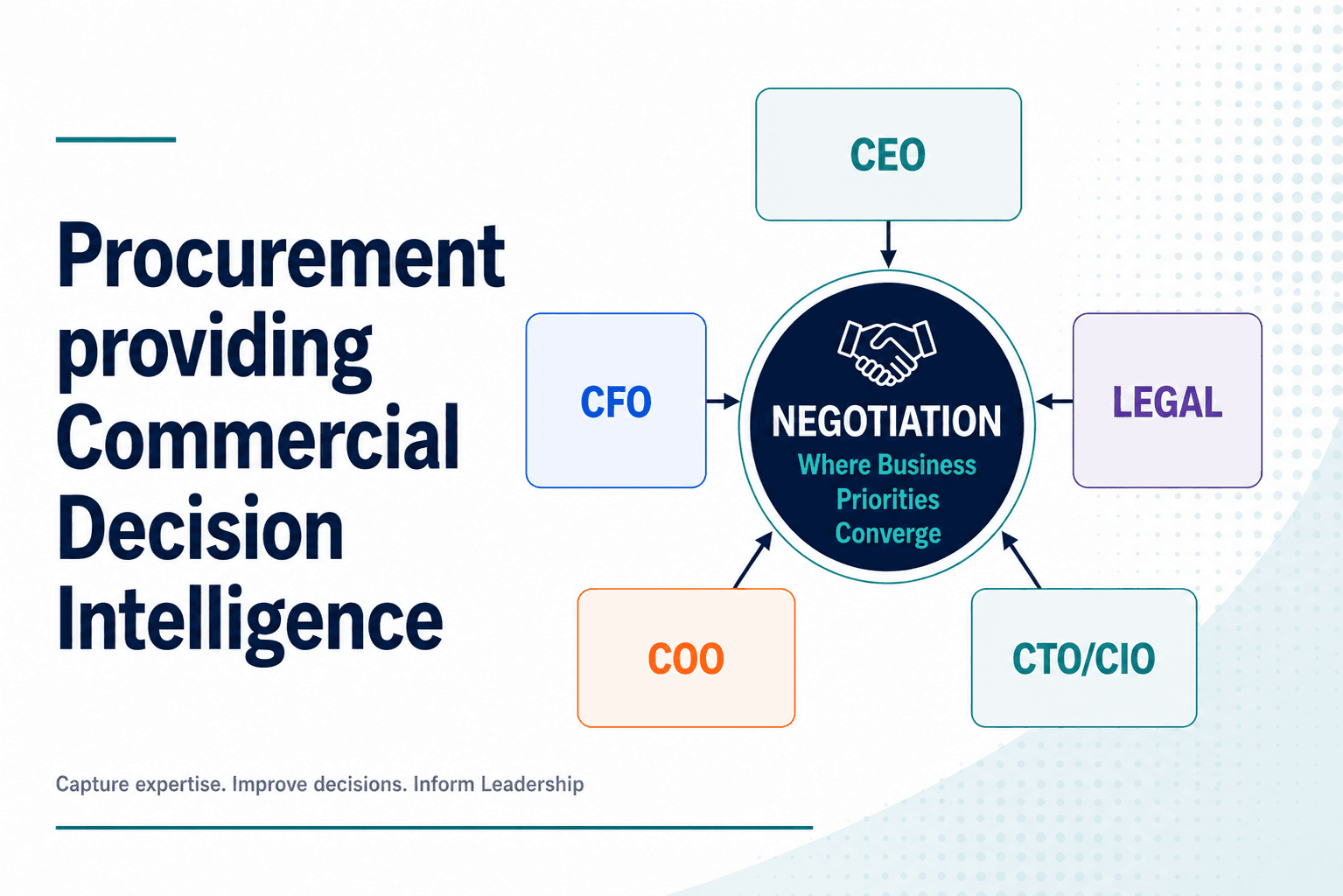
Modern procurement teams are therefore doing more than running sourcing events. They are increasingly becoming the point where business priorities converge before a commercial commitment is made.
The challenge is not simply to collect more inputs. It is to understand how those inputs interact, where trade-offs exist, and which combination creates the strongest commercial outcome.
2. More Information Does Not Automatically Create Better Decisions
Organizations already have enormous amounts of information. The problem is that it is fragmented.
- Finance understands value and return.
- Legal understands contractual exposure.
- Technology understands architecture, integration, and technical requirements.
- Operations understands execution and adoption.
- Risk understands governance and exposure.
- Business stakeholders understand the desired outcome.
- Procurement understands the commercial process.
The commercial decision depends on bringing these perspectives together at the right moment and translating them into a coherent strategy. As complexity increases, traditional documents, spreadsheets, meetings, and individual experience become harder to connect consistently.
3. A New Strategic Capability
Commercial Decision Intelligence is an organization’s ability to systematically bring together market intelligence, institutional knowledge, stakeholder priorities, commercial alternatives, risk considerations, and negotiation strategy to improve important procurement decisions.
It shifts the focus from simply managing a sourcing process to improving the quality, consistency, and rationale of the decisions made throughout that process.
4. The Commercial Decision Intelligence Framework
Strategic procurement decisions increasingly require consideration of multiple business priorities together. The framework illustrates how these perspectives converge into a commercial decision.
Commercial Decision Intelligence should begin before the negotiation itself. Business stakeholders often initiate complex purchases before critical commercial, legal, technology, operational, or governance requirements are fully considered. When these issues surface late, procurement can appear to be slowing the process when the underlying problem is an earlier planning gap.
Leading organizations surface the right questions at initiation and revisit them at key decision points, making governance part of the negotiation rather than a roadblock at the end.
Late-stage procurement emergencies often begin as early-stage planning gaps.
Better commercial decisions emerge when business priorities are evaluated together rather than in isolation.
5. From Bid Analysis to Decision Intelligence
Traditional procurement processes remain essential, but the decision challenge is expanding. Leading organizations increasingly need to understand not only what suppliers offer, but why one commercial path creates a stronger overall business outcome.
| Traditional Procurement Decision | Commercial Decision Intelligence |
|---|---|
| What is the best price? | What creates the best business outcome? |
| What did suppliers bid? | What do we know about the supplier and market? |
| What terms can we negotiate? | What trade-offs should we make? |
| What does procurement recommend? | What do stakeholders collectively prioritize? |
| What should we award? | Why is this the right commercial decision? |
| Record the outcome | Preserve the decision rationale |
6. Questions Every Procurement Leader Should Ask
- How often are major negotiations delayed near the finish line because critical leadership, governance, or stakeholder requirements were not identified early enough?
- Can procurement consistently reconcile competing priorities across finance, legal, technology, operations, risk, and the business?
- Can decision-makers understand not only what was recommended, but why?
- Does each major commercial decision make the next decision better?
7. The Negotiations.AI Perspective
Negotiations.AI is built on the belief that better commercial outcomes begin with better-informed decisions. The platform can help teams surface relevant commercial, stakeholder, governance, and risk questions when a project is initiated, then bring together institutional knowledge, market intelligence, stakeholder priorities, negotiation strategy, commercial alternatives, and outcomes so decision-makers can evaluate trade-offs with greater context and consistency.
Rather than replacing existing procurement platforms, Negotiations.AI adds intelligence to the decisions where commercial value, business priorities, and risk converge.