N
Negotiations.AI
AI Negotiation Simulation

Rehearse the supplier conversation before the pressure is real

Turn an approved negotiation plan into realistic voice or video practice, test difficult response paths, receive evidence-based feedback, and repeat until the team can execute under pressure.

Pressure-test the strategy before the stakes are real.

  • Rehearse realistic supplier pushback
  • Receive feedback while you practice
  • Revise the plan before the meeting
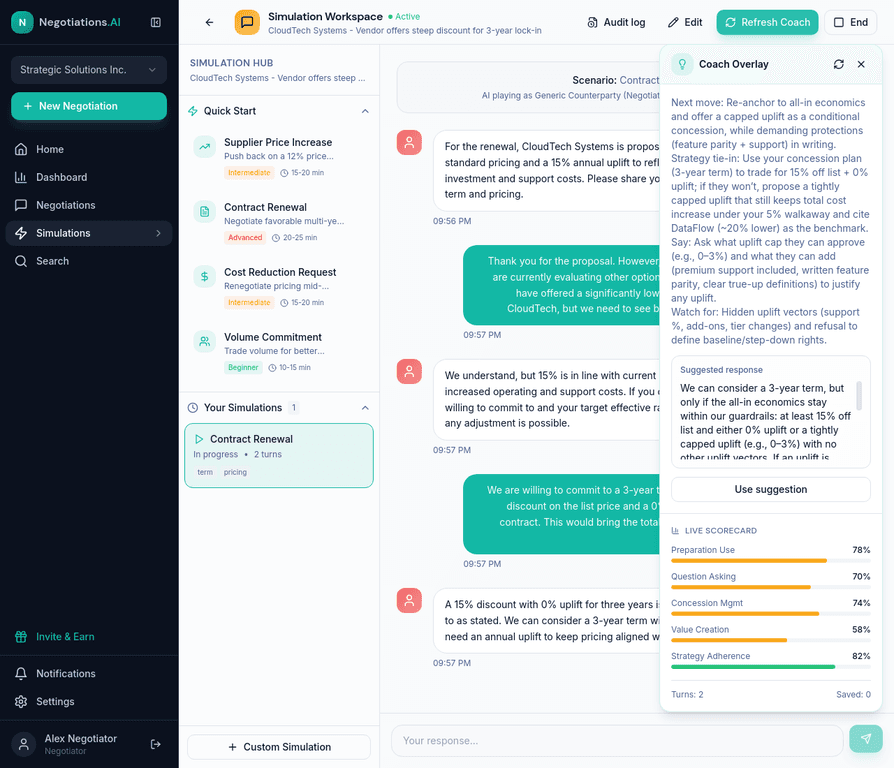
Negotiations.AI simulation workspace with supplier dialogue, coach guidance, and a live scorecard

Simulation workspace

Explore voice negotiation simulation

What you leave with

Practice the moments most likely to break the plan

Run focused rehearsals for openings, objections, cost claims, stalled concessions, internal pauses, and the close.

Simulation should pressure-test the plan, not reward theatrics

The purpose of simulation is not to produce a generic confidence score. It is to reveal whether the strategy is usable: can the negotiator ask the right questions, listen, defend evidence, package issues, manage concessions, stay inside authority, and adapt when the supplier does something unexpected?
Deal-specific

Ground the counterparty, objections, constraints, evidence, and success criteria in the actual negotiation context.

Behavior-observable

Score choices that can be seen or heard rather than inferring personality, intent, or hidden psychological traits.

Repeatable

Run alternative paths and difficult moments repeatedly without consuming supplier access or facilitator time.

What is an AI negotiation simulation?

Negotiation simulation is a structured rehearsal in which a person or AI plays the counterparty and responds to the negotiator's choices. Effective simulations use realistic deal context, objectives, constraints, behaviors, and scoring criteria so teams can test strategy, practice language, identify weak assumptions, and improve execution before a live negotiation.

Inside Negotiations.AI

Step into a strategy-grounded AI negotiation simulation

Practice against an AI counterparty, keep the coach available, and use observable feedback to sharpen the next attempt.

Ground outputs in deal context and evidence
Keep humans responsible for review and approval
Carry learning into the next negotiation round
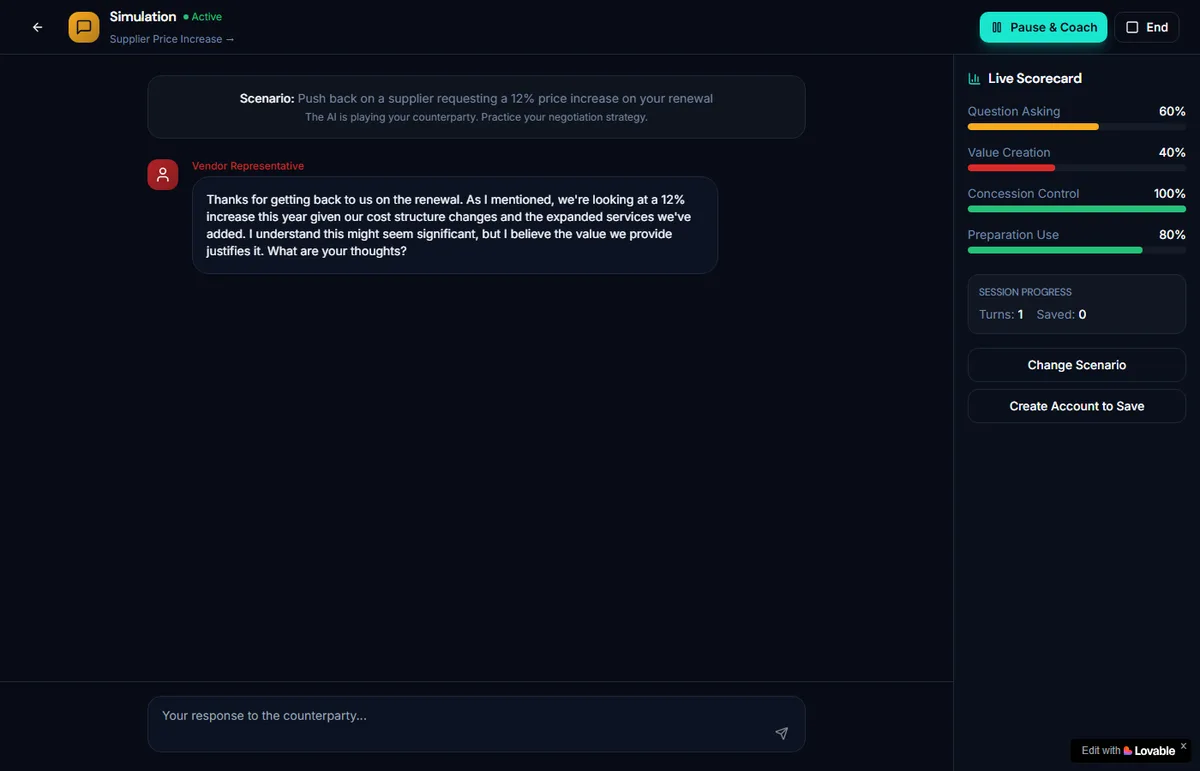
Dark negotiation simulation interface with supplier scenario and skill scorecard

Immersive rehearsal

Explore video negotiation simulation

Choose a focused scenario and rehearse the conversation in an environment closer to the real meeting.

Product output

Scenario configuration

Convert objectives, ranges, leverage, packages, and supplier context into a realistic practice case.

Product output

Voice and video rehearsal

Practice the actual conversation against changing objections and response paths.

Product output

Observable feedback

Review questions, evidence, listening, packaging, concession discipline, clarity, and next moves.

Product output

Readiness history

Track recurring gaps, improvements, scenario coverage, and lessons across individuals and teams.

Run the rehearsal

How to run a useful negotiation simulation

A simulation creates value when scenario design, execution, feedback, and revision remain tied to the real negotiation plan.

  1. 01

    Choose the moment

    Select the decision, objection, trade, conflict, or pressure point the negotiator most needs to practice.

  2. 02

    Configure the counterparty

    Define the supplier role, interests, constraints, style, information, opening position, authority, and likely responses.

  3. 03

    Set observable criteria

    Score evidence use, questions, listening, issue packaging, concession discipline, clarity, authority, and next-step capture.

  4. 04

    Run the conversation

    Practice in voice or video without pausing to explain; capture choices, turning points, offers, and missed information.

  5. 05

    Debrief and repeat

    Review evidence, identify one or two material changes, update the plan, and rerun the moment under a different response path.

Use it when

Negotiation moments worth simulating

Prioritize moments where poor execution would destroy leverage, create an unapproved commitment, or make recovery difficult.

Challenging a price increase

Practice testing cost claims, holding silence, separating issues, introducing evidence, and making movement conditional.

Managing a hard anchor

Rehearse responses that avoid accepting the counterparty's frame while preserving curiosity and commercial momentum.

Handling an executive escalation

Prepare leaders to protect authority, communicate risk, avoid accidental commitments, and define a controlled next step.

Coordinating a negotiation team

Practice handoffs, internal pauses, expert contributions, note capture, and signals between team members.

Ground the recommendation

Inputs that make an AI simulation realistic

The simulation should be grounded enough to test the real plan without pretending to know private facts or predict exactly what the supplier will do.

Approved plan

Objectives, ranges, BATNA, leverage, packages, questions, guardrails, roles, and escalation triggers.

Counterparty context

Known interests, constraints, history, behavior, performance, alternatives, stakeholders, and likely approval process.

Scenario assumptions

Opening position, available information, simulated constraints, uncertainty, trigger events, and alternative response paths.

Scoring criteria

Observable behaviors, decision quality, authority compliance, evidence use, outcome progress, and capture of next steps.

Choose deliberately

Choose the simulation format for the learning objective

Different formats train different aspects of readiness. Use the lightest format that reproduces the pressure or behavior you need to improve.

ApproachPrimary jobHuman roleBest fit
Scenario tabletopDiscuss choices and consequences without acting out the meetingChallenge assumptions and compare response pathsStrategy review and cross-functional alignment
Text simulationPractice decision sequences and written responsesTest logic, evidence, packages, and escalationRapid iteration and asynchronous preparation
Voice simulationPractice language, listening, timing, and verbal fluencySpeak, adapt, and manage the flow in real timeObjections, anchors, questions, and concession moments
Video simulationAdd presence, pacing, team coordination, and visual pressureIntegrate verbal delivery, observation, and executive presenceHigh-stakes meetings and leadership rehearsal

How to use simulation scores responsibly

Scores should reflect explicit, observable criteria tied to the scenario and should support coaching rather than employment decisions in isolation. Avoid unsupported claims about personality, emotion, intent, deception, or guaranteed real-world performance.

Keep exploring

Related guides and product paths

Use the next most relevant resource instead of starting another search from scratch.

Common questions

AI Negotiation Simulation FAQ

What is a negotiation simulation?+

A negotiation simulation is a controlled rehearsal where another person or an AI plays the counterparty. It lets negotiators test strategy, practice difficult moments, receive feedback, and revise the plan before a real negotiation.

Can AI realistically simulate a supplier?+

AI can generate plausible responses from configured context, constraints, and behaviors, but it cannot know exactly what a supplier will do. Treat the simulation as a pressure test across possible paths, not a prediction.

What should a negotiation simulation score?+

Score observable behaviors and decisions such as question quality, listening, evidence use, issue packaging, concession discipline, clarity, authority compliance, adaptability, and next-step capture.

How often should teams practice a negotiation?+

Practice until the team can handle the most consequential moments without losing the strategy or exceeding authority. Short, repeated simulations of specific moments are often more useful than one long generic role-play.

Bring one real negotiation

Let the first difficult conversation be a simulation.

Practice a real negotiation scenario with voice, video, or text before you meet the counterparty.