N
Negotiations.AI
Negotiation Preparation

Prepare the decisions before you prepare the talking points

Effective preparation turns scattered facts and stakeholder opinions into an aligned position, credible alternatives, tradable packages, approved guardrails, and a team ready for the conversation.

Replace the blank page with a guided, reviewable preparation flow.

  • Capture the situation quickly
  • Expose missing evidence
  • Leave with an approved brief
What you leave with

Preparation that ends in decisions—not more notes

Structure the facts, people, ranges, trades, questions, roles, and approvals the team needs before it meets the counterparty.

Preparation is a readiness test, not a longer document

A team is prepared when it knows which facts are reliable, which assumptions need testing, what outcomes matter, what it can trade, who can approve movement, and how it will respond when the conversation departs from the expected path. The deliverable should make those choices usable, not bury them in slides.
Evidence-tested

Resolve material conflicts and gaps before they become weak claims in front of the counterparty.

Stakeholder-aligned

Agree priorities, constraints, trade authority, roles, and escalation paths across the deal team.

Conversation-ready

Prepare questions, packages, language, roles, scenarios, and pauses the team can actually use live.

What is negotiation preparation?

Negotiation preparation is the practical work completed before a negotiation: collecting and testing evidence, aligning stakeholders, setting objectives and limits, validating alternatives, identifying leverage, designing questions and trade packages, assigning roles, approving authority, and rehearsing likely scenarios. Good preparation reduces avoidable decisions under pressure.

Inside Negotiations.AI

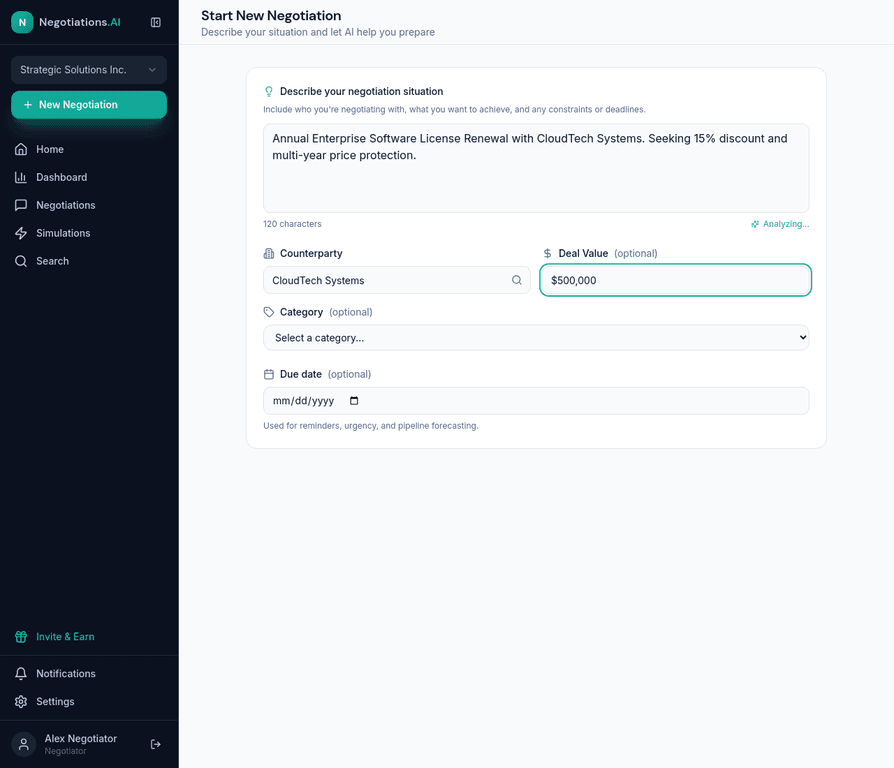
See AI negotiation preparation go from brief to workspace

Start with the situation in plain language, then deepen the plan with documents, assumptions, and stakeholder input.

Ground outputs in deal context and evidence
Keep humans responsible for review and approval
Carry learning into the next negotiation round
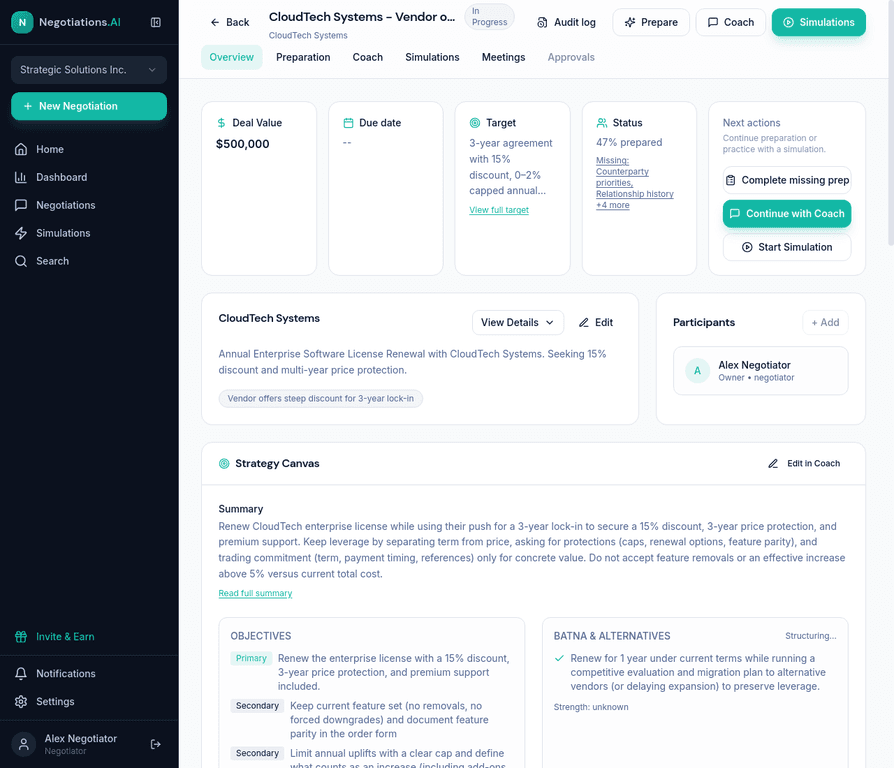
Negotiations.AI prepared negotiation overview with targets, participants, and strategy canvas

Preparation output

See the completed preparation workspace

The result is a shared strategy canvas with targets, alternatives, participants, and next actions.

Product output

Readiness intake

Identify missing documents, decision owners, stakeholder conflicts, deadlines, risks, and required approvals.

Product output

Evidence map

Organize commercial history, supplier claims, benchmarks, assumptions, contradictions, and unanswered questions.

Product output

Approved preparation brief

Bring objectives, ranges, leverage, packages, roles, guardrails, and scenarios into one usable view.

Product output

Rehearsal and feedback

Practice high-pressure moments, score observable choices, and update the plan before the real meeting.

Prepare the negotiation

A negotiation preparation checklist that produces readiness

Complete the work in sequence so that later choices are grounded in evidence rather than unsupported targets.

  1. 01

    Define the negotiation

    Clarify scope, participants, decision date, dependencies, value, risk, and the outcomes the meeting must advance.

  2. 02

    Build the fact base

    Gather agreements, spend, performance, usage, proposals, benchmarks, history, supplier claims, and unresolved evidence gaps.

  3. 03

    Set ranges and alternatives

    Validate BATNA, estimate the ZOPA, set targets and limits, and document the assumptions behind each number.

  4. 04

    Design the conversation

    Prepare diagnostic questions, sequencing, anchors, issue packages, conditions, concession rules, and likely response paths.

  5. 05

    Approve and rehearse

    Assign roles, secure authority, simulate difficult moments, close critical gaps, and issue a concise final brief.

Use it when

When structured preparation matters most

Preparation should be proportionate, but higher-value and harder-to-reverse decisions deserve a more explicit readiness standard.

Price-increase meetings

Prepare cost-driver questions, counter-evidence, volume and term trades, affordability limits, and conditional responses.

Renewal negotiations

Connect notice dates, performance, utilization, alternatives, transition readiness, open issues, and future demand.

Executive negotiations

Give leaders a concise brief with choices, risks, messages, authority, roles, and escalation triggers.

Team-based negotiations

Coordinate the lead negotiator, subject experts, note taker, observer, approver, and internal communication channel.

Ground the recommendation

Evidence to collect before the negotiation

Collect only what can change a decision, support a claim, expose a risk, improve a question, or strengthen an executable alternative.

Agreement and spend

Contracts, amendments, orders, invoices, price history, volume, usage, rebates, credits, and total-cost drivers.

Performance and risk

Service levels, incidents, quality, delivery, innovation, dependency, compliance, disputes, and remediation history.

Market and alternatives

Benchmarks, indices, comparable offers, capacity, substitutes, switching requirements, qualification, and lead times.

Stakeholder decisions

Priorities, constraints, budgets, requirements, approval limits, legal positions, implementation needs, and walk-away logic.

Choose deliberately

Preparation artifacts and the job each performs

The goal is not to force every decision into a single template, but to make the critical choices visible and connected.

ApproachPrimary jobHuman roleBest fit
Fact baseEstablish what is known, assumed, disputed, and missingValidate sources and decide whether evidence is decision-readyPreventing weak or contradictory claims
Strategy briefDefine objectives, ranges, leverage, packages, and response pathsChoose the commercial logic and accept the risksAligning the team on how value will be pursued
Authority matrixMake decision rights, limits, and escalation explicitApprove movement and remain accountable for exceptionsCross-functional or high-risk negotiations
Rehearsal scorecardTest execution against observable behaviors and outcomesPractice, receive feedback, and revise the planDifficult conversations and less-experienced teams

How the checklist avoids false readiness

The preparation model distinguishes collecting information from making decisions. A completed template is not readiness unless the evidence has been tested, conflicts have owners, authority is explicit, alternatives are executable, and the team has rehearsed its most consequential choices.

Keep exploring

Related guides and product paths

Use the next most relevant resource instead of starting another search from scratch.

Common questions

Negotiation Preparation FAQ

How do you prepare for a negotiation?+

Define the decision and participants, build a fact base, set objectives and limits, validate BATNA and ZOPA, map leverage, understand counterparty interests, design questions and trade packages, approve authority, assign roles, and rehearse likely scenarios.

What is the most important part of negotiation preparation?+

The most important part is converting evidence and stakeholder priorities into explicit choices: targets, limits, alternatives, tradable issues, authority, and response paths. Research without those decisions rarely changes the meeting.

How long should negotiation preparation take?+

Preparation should be proportionate to value, risk, complexity, novelty, and reversibility. A routine renewal may need a short structured review; a strategic or contested agreement may require cross-functional analysis, approvals, and repeated rehearsal.

Can AI help prepare for a negotiation?+

AI can organize documents, summarize history, expose gaps, compare evidence, draft questions, model options, and run simulations. Humans should validate inputs and retain responsibility for judgment, authority, relationships, and commitments.

Bring one real negotiation

Prepare the next supplier meeting with less blank-page work.

Start with the deal in plain language and build a preparation brief your team can review together.