N
Negotiations.AI
AI Negotiation Assistant

An AI negotiation assistant that supports judgment instead of replacing it

Bring evidence, approved strategy, relevant questions, guardrails, and institutional memory into the negotiation workflow—before, during, and after the supplier conversation.

Keep the plan visible before, during, and after the conversation.

  • Surface the next best question
  • Protect approved concession limits
  • Capture actions and learning
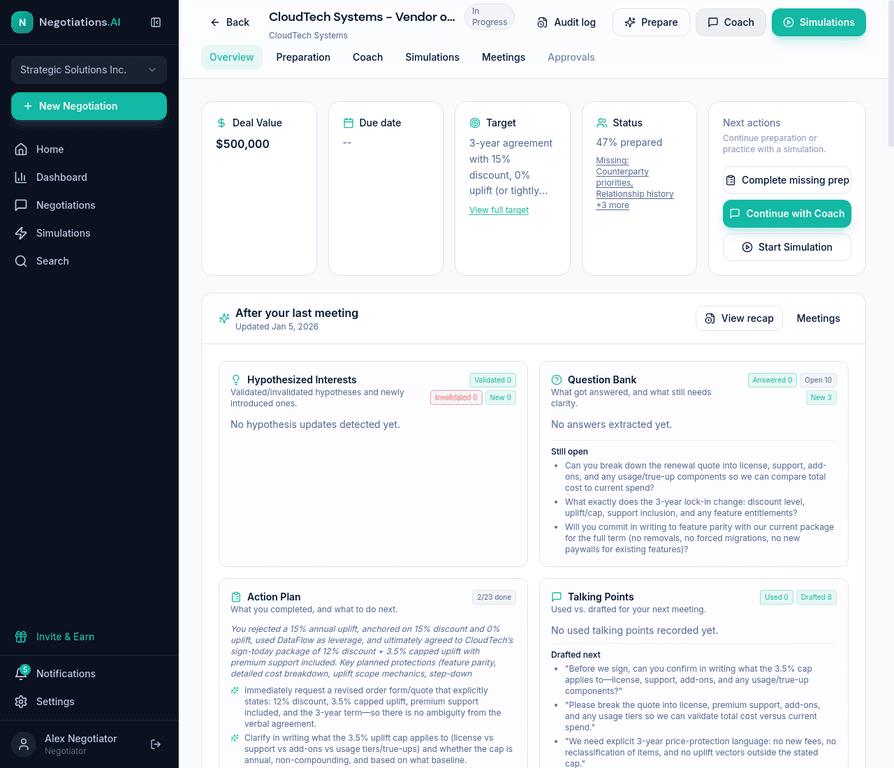
Negotiations.AI execution workspace with open questions, talking points, and a negotiation action plan

Execution workspace

Explore the Live Negotiation Coach

What you leave with

An assistant that strengthens judgment instead of replacing it

Use AI to organize context, prepare moves, and preserve memory while the human negotiator owns the relationship and every commitment.

The assistant should understand the approved plan

Generic meeting assistants can transcribe and summarize. A negotiation assistant needs a commercial model of the deal: objectives, facts, assumptions, ranges, leverage, trade packages, questions, risks, and authority. Guidance is useful only when it remains grounded in that context and subordinate to the negotiator's judgment.
Evidence-linked

Tie suggestions to trusted commercial inputs and identify when evidence is missing, conflicting, or uncertain.

Guardrail-aware

Respect approved targets, concession rules, contractual constraints, role permissions, and escalation paths.

Human-controlled

Keep listening, relationship judgment, supplier-facing language, commitments, and approval with accountable people.

What is an AI negotiation assistant?

An AI negotiation assistant is software that helps a human negotiator organize evidence, prepare positions and trades, rehearse scenarios, receive context-aware guidance, and capture commitments and learning. It should make sources, uncertainty, authority, and human approval visible rather than autonomously inventing or accepting commercial terms.

Inside Negotiations.AI

Carry the AI negotiation assistant into the live conversation

The product connects preparation, private in-meeting guidance, and the post-meeting action plan so the next round starts smarter.

Ground outputs in deal context and evidence
Keep humans responsible for review and approval
Carry learning into the next negotiation round
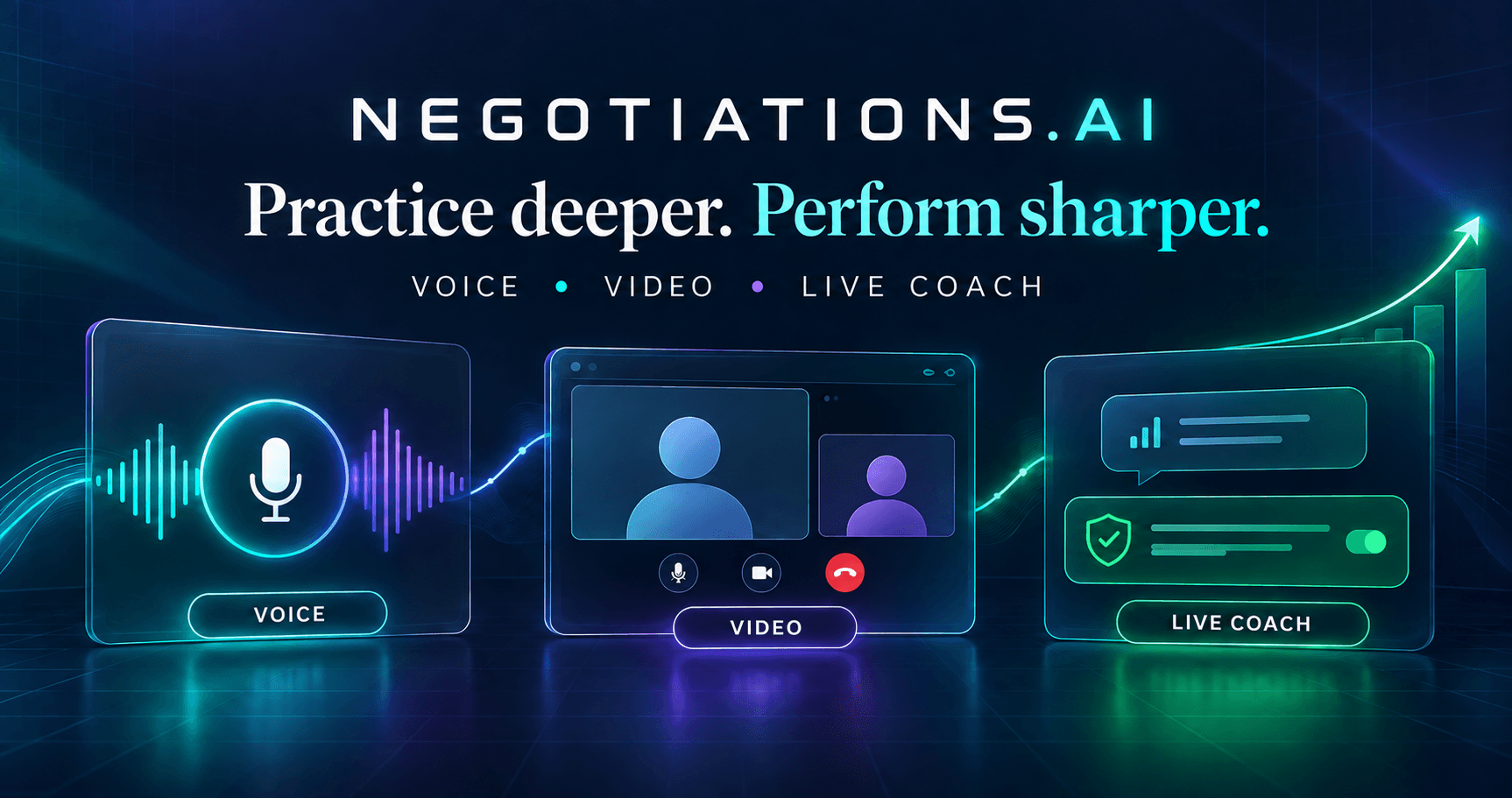
Negotiations.AI voice, video, and Live Negotiation Coach product experiences

Private live guidance

See live negotiation coaching

Connect practice and live support without handing control of the negotiation to the AI.

Product output

Guided negotiation intake

Turn a short request into required evidence, stakeholder questions, gaps, and a preparation path.

Product output

Approved decision context

Carry objectives, ranges, leverage, packages, guardrails, and authority into every stage of the workflow.

Product output

Context-aware guidance

Surface focused questions and next moves tied to the plan, conversation, and available evidence.

Product output

Outcome memory

Preserve offers, commitments, decisions, supplier behavior, and lessons for future negotiations.

Use the assistant

How an AI negotiation assistant supports the full workflow

The assistant becomes more useful when the same structured context follows the negotiation from intake through learning.

  1. 01

    Capture context

    Collect the deal, stakeholders, objectives, supplier history, deadlines, constraints, documents, and missing evidence.

  2. 02

    Build the plan

    Organize ranges, alternatives, leverage, questions, packages, scenarios, roles, approvals, and decision triggers.

  3. 03

    Rehearse pressure

    Simulate likely objections, information gaps, emotional moments, and supplier moves before the meeting.

  4. 04

    Support the meeting

    Surface concise questions, reminders, evidence, guardrails, and possible next moves without taking control away from the negotiator.

  5. 05

    Capture learning

    Record offers, commitments, rationale, unresolved points, outcomes, supplier behavior, and reusable lessons.

Use it when

Where a negotiation assistant earns trust

The best use cases combine meaningful commercial decisions with evidence the assistant can structure and outputs a human can review.

Preparing a supplier meeting

Assemble contracts, spend, performance, benchmarks, prior discussions, objectives, and open questions into a reviewable brief.

Handling supplier objections

Recall approved questions, relevant facts, planned trades, and escalation boundaries while the negotiator manages tone and timing.

Coordinating a deal team

Keep finance, legal, procurement, operations, and executives aligned on roles, assumptions, authority, and unresolved choices.

Building institutional memory

Convert scattered notes and individual experience into governed records that improve future strategy and onboarding.

Ground the recommendation

Context an AI negotiation assistant should be able to use

An assistant should distinguish trusted inputs from assumptions and generated suggestions, then show users what supports each recommendation.

Deal context

Scope, objectives, deadlines, stakeholders, dependencies, history, value, complexity, and unresolved decisions.

Commercial evidence

Contracts, spend, pricing, volume, performance, benchmarks, supplier communications, and credible market signals.

Approved strategy

Targets, limits, BATNA, ZOPA, leverage, questions, packages, concession rules, and escalation triggers.

Governance controls

Permissions, consent, retention, confidentiality, audit history, model limitations, and human approval requirements.

Choose deliberately

Negotiation assistants are not all the same

Compare products by the decision they support, the context they retain, and the authority they are allowed to exercise.

ApproachPrimary jobHuman roleBest fit
Meeting assistantTranscribe, summarize, and identify generic actionsInterpret commercial meaning and decide what mattersMeeting notes and follow-up administration
Preparation assistantResearch, structure inputs, and draft a negotiation planValidate evidence and approve positions and tradesPre-meeting analysis and stakeholder alignment
Live negotiation coachSurface context-aware prompts and guardrails during a meetingListen, choose the move, speak, and own the relationshipHigh-value live supplier negotiations
Autonomous negotiation agentConduct bounded exchanges within predefined rulesSet authority, monitor, approve exceptions, and interveneRepeatable, lower-risk transactions with explicit limits

How to evaluate assistant quality

Evaluate the assistant across evidence grounding, workflow fit, latency, permissioning, uncertainty, auditability, user control, measurable decision quality, and the cost of an incorrect or badly timed suggestion.

Keep exploring

Related guides and product paths

Use the next most relevant resource instead of starting another search from scratch.

Common questions

AI Negotiation Assistant FAQ

What does an AI negotiation assistant do?+

It helps negotiators assemble evidence, structure strategy, rehearse scenarios, receive context-aware prompts, document commitments, and preserve learning. Capabilities vary, so buyers should distinguish preparation tools, live coaches, meeting assistants, and autonomous agents.

Can an AI negotiation assistant join a live meeting?+

Some assistants can support live meetings with transcription, reminders, evidence, questions, and suggested next moves. Organizations should address participant consent, confidentiality, retention, security, accuracy, and human control before use.

Is a negotiation assistant the same as a chatbot?+

No. A generic chatbot responds to prompts. A negotiation assistant should retain structured deal context, connect guidance to evidence and approved strategy, respect permissions and guardrails, and support a governed commercial workflow.

Should AI be allowed to make commitments to suppliers?+

Material commercial commitments should remain subject to explicit authority and human approval. Any autonomous interaction should be bounded, monitored, auditable, and able to escalate exceptions to an accountable person.

Bring one real negotiation

Give every negotiator a better prepared next move.

See how a governed AI negotiation assistant can support preparation, execution, and follow-through.