Portfolio visibility
See upcoming negotiations, value, urgency, complexity, dependencies, and capacity in one governed pipeline.
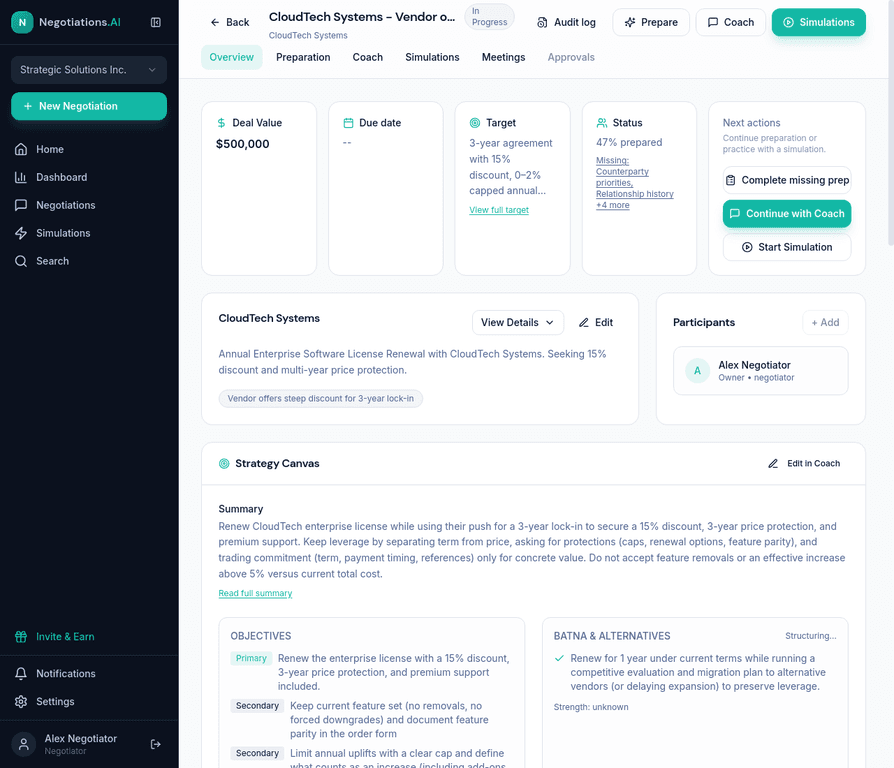
Negotiation management gives teams a repeatable way to identify important negotiations, assign ownership, prepare decisions, govern approvals, capture outcomes, and reuse what the organization learns.
Related category: Negotiation planning
Quick answer
Negotiation management is the operating system used to coordinate negotiations across a team or enterprise. It covers intake, prioritization, roles, planning standards, approvals, execution records, outcome measurement, risk escalation, and knowledge reuse so negotiation performance does not depend on individual memory alone.
Training improves negotiators; management improves the system around them. The goal is not to centralize every decision, but to make ownership, evidence, authority, risk, and learning visible across the negotiation portfolio.
See upcoming negotiations, value, urgency, complexity, dependencies, and capacity in one governed pipeline.
Apply proportionate standards for preparation, approval, exceptions, commitments, and escalation.
Connect planned positions, actual exchanges, outcomes, realized value, and reusable lessons.
The lifecycle links opportunity selection to realized outcomes and learning.
Record the negotiation, business stakes, deadlines, risks, stakeholders, and required support.
Set accountable roles and apply the planning standard appropriate to value and complexity.
Confirm evidence, positions, authority, contractual risks, and escalation paths.
Capture offers, decisions, commitments, unresolved issues, and changes to the approved plan.
Track realized value, compliance, relationship outcomes, and lessons for future negotiations.
The systems can integrate, but they own different decisions and records.
| Category | Primary job | Human role | Best fit |
|---|---|---|---|
| Negotiation management | Coordinate negotiation decisions and learning | Own strategy, authority, execution, and outcomes | Pipeline, planning, approvals, records, and coaching |
| CLM | Manage contract drafting and obligations | Approve legal and commercial terms | Redlines, signatures, clauses, and obligations |
| SRM | Manage supplier performance and relationships | Set governance and improvement actions | Scorecards, reviews, risk, and development |
| Sourcing suite | Run competitive sourcing events | Design events and select suppliers | RFx, bids, evaluation, and awards |
The model treats negotiation management as a lifecycle of accountable decisions rather than a document repository. Supporting articles cover governance, roles, portfolio views, measurements, risks, and software requirements in depth.
Apply the system across recurring and strategic negotiations without imposing the same level of process on every deal.
Detect renewal dates early, assign owners, group related suppliers, and protect preparation lead time.
Triage requests by value, evidence quality, urgency, supplier risk, and available response options.
Coordinate executive sponsors, category teams, legal, finance, operations, and technical experts.
Use observable preparation and execution evidence to guide coaching and playbook improvements.
Better AI negotiation outputs start with the same thing stronger human negotiators use: clear facts, explicit constraints, and a disciplined view of leverage.
Pipeline record
Opportunity, owner, value, deadline, complexity, status, stakeholders, and risk.
Decision record
Evidence, assumptions, options, approvals, exceptions, and decision rationale.
Execution record
Offers, concessions, commitments, meeting outcomes, actions, and unresolved issues.
Outcome record
Agreed value, realized value, compliance, supplier performance, relationship impact, and lessons.
Build the approved plan used within the management lifecycle.
Compare software capabilities for supplier negotiations.
Preserve commercial knowledge as a governed enterprise asset.
Standardize preparation without removing professional judgment.
Connect supplier management and renewal negotiation work.
Negotiation management is the process and system used to prioritize, prepare, govern, record, measure, and learn from negotiations across an organization.
No. Contract management owns documents, clauses, signatures, and obligations. Negotiation management owns the decisions, exchanges, authority, and learning that produce and change commercial agreements.
Track pipeline, ownership, evidence, plans, approvals, offers, concessions, commitments, outcomes, realized value, risks, and reusable lessons.
No. Apply proportionate requirements based on value, complexity, risk, novelty, and stakeholder impact while preserving minimum ownership and record standards.
Start with a real negotiation, add the facts you trust, and pressure-test the plan before the supplier meeting.