N
Negotiations.AI
Negotiation Strategy

Build a negotiation strategy that survives contact with the other side

A strong strategy connects the outcome you want to the evidence, leverage, alternatives, trades, decision rights, and response paths needed to reach it without improvising away value.

Move from a list of goals to an approved, adaptable plan.

  • Set targets and walk-away points
  • Design conditional trade packages
  • Prepare responses before pressure hits
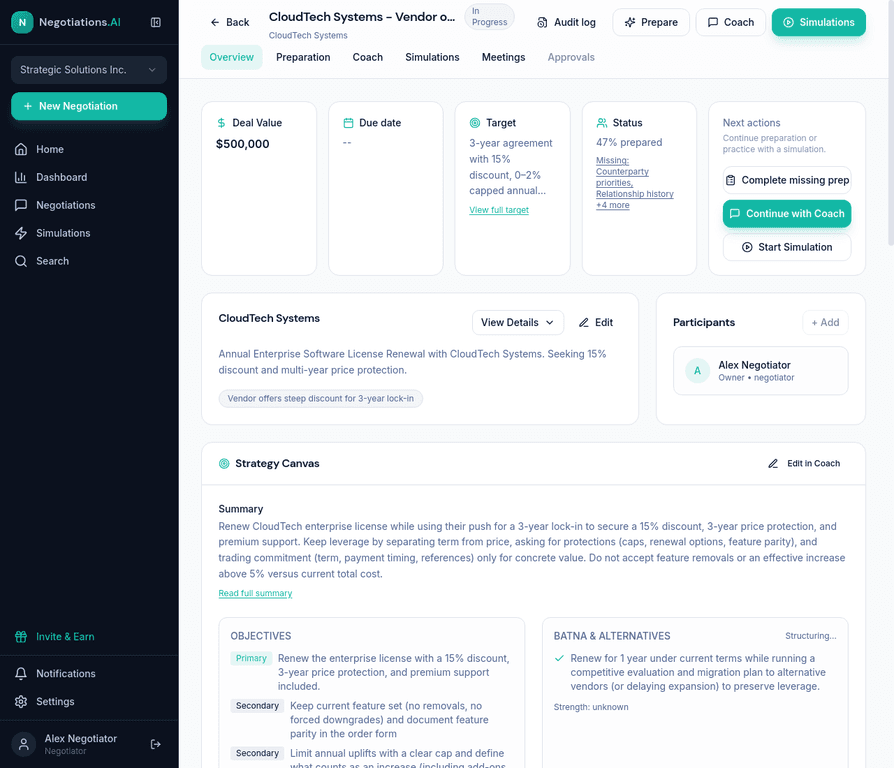
Negotiations.AI strategy workspace showing objectives, BATNA, target, status, and next actions

Strategy workspace

Explore the negotiation strategy workspace

What you leave with

A strategy your team can actually use in the room

Bring objectives, leverage, alternatives, questions, trades, and authority into one working view—not six disconnected documents.

Strategy turns analysis into conditional choices

Useful strategies do not predict a single conversation. They define a small number of evidence-based paths, each with assumptions, opening positions, diagnostic questions, tradable packages, concession conditions, approval boundaries, and decision triggers. This gives negotiators room to adapt while keeping value and authority visible.
Outcome-led

Translate broad ambitions into prioritized outcomes, acceptable ranges, dependencies, and measurable success criteria.

Exchange-designed

Create multi-issue packages and conditional trades instead of treating every concession as a one-way loss.

Decision-ready

Define authority, escalation points, walk-away logic, and evidence requirements before time pressure begins.

What is a negotiation strategy?

A negotiation strategy is the set of coordinated choices that determines what the team will pursue, how it will create and claim value, which information it needs, what it can exchange, how it will respond to likely counterparty moves, and when it will pause, escalate, or walk away. It is broader than a list of tactics and more decision-oriented than a meeting agenda.

Inside Negotiations.AI

See an AI negotiation strategy become a working canvas

Negotiations.AI turns evidence and stakeholder constraints into a reviewable strategy, then carries it into practice and execution.

Ground outputs in deal context and evidence
Keep humans responsible for review and approval
Carry learning into the next negotiation round
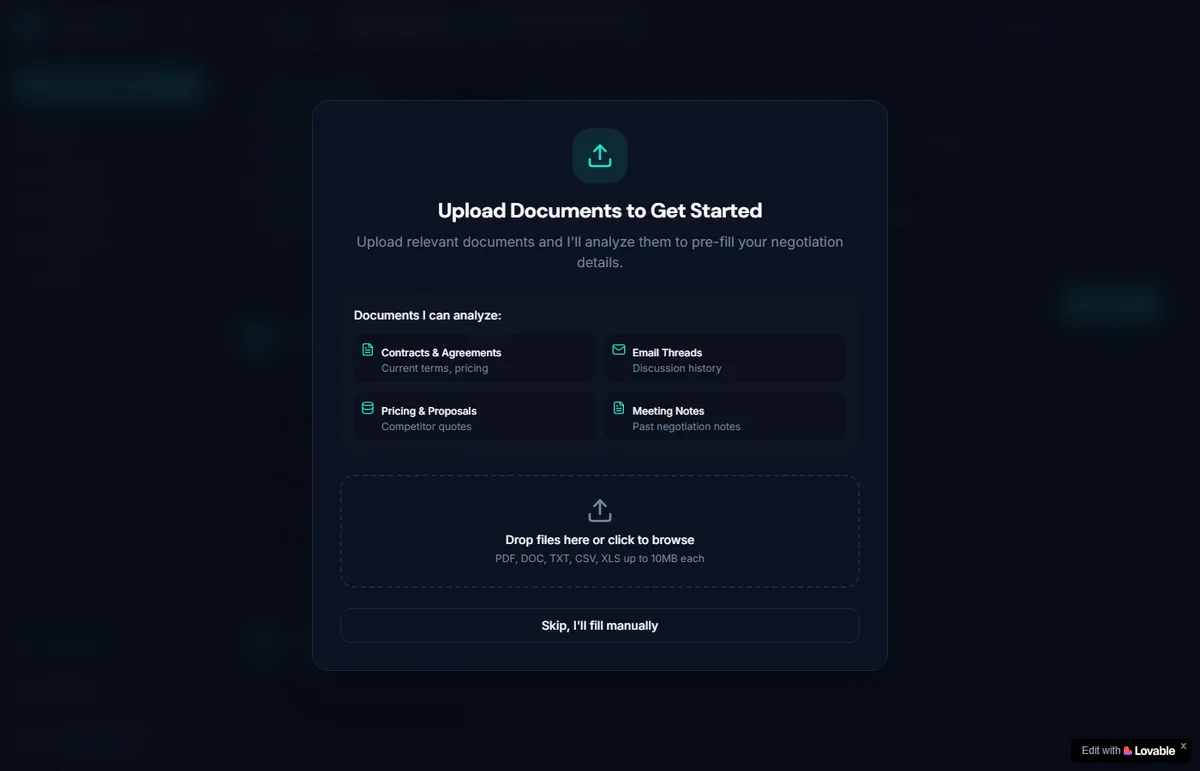
Negotiations.AI evidence intake for contracts, pricing, proposals, email threads, and meeting notes

Evidence intake

See evidence-led negotiation planning

Start from the documents and facts your team already trusts, with manual review always available.

Product output

Strategy fact base

Separate verified facts, working assumptions, evidence gaps, stakeholder constraints, and counterparty signals.

Product output

Range and leverage map

Connect BATNA, ZOPA, targets, limits, leverage, risks, and approval authority in one decision view.

Product output

Trade-package design

Prepare conditional give/get packages, questions, anchors, and planned responses to likely supplier moves.

Product output

Strategy pressure test

Rehearse objections and alternative paths before the team has to make decisions under pressure.

Build the strategy

A five-part negotiation strategy framework

Build the strategy in an order that keeps targets connected to evidence and supplier-facing moves connected to approval authority.

  1. 01

    Frame the outcome

    Prioritize commercial, operational, relationship, risk, and implementation outcomes; distinguish requirements from preferences.

  2. 02

    Establish the range

    Validate BATNA, estimate the ZOPA, set targets and limits, and document which assumptions could move the range.

  3. 03

    Map leverage

    Identify credible alternatives, timing, information, dependency, competition, switching readiness, and value the other side needs.

  4. 04

    Design the exchange

    Build packages, questions, anchors, conditions, and concession sequences across multiple issues rather than price alone.

  5. 05

    Prepare response paths

    Model likely counterparty moves, define pause and escalation triggers, assign roles, and approve the strategy.

Use it when

Where a written negotiation strategy creates leverage

The greater the value, uncertainty, dependency, or stakeholder disagreement, the more costly it becomes to rely on instinct alone.

Supplier price increases

Separate legitimate cost movement from unsupported claims, prepare diagnostic questions, and exchange any movement for measurable value.

Contract renewals

Use performance, utilization, switching readiness, deadlines, alternatives, and future commitments to rebalance leverage.

Sole-source negotiations

Create leverage through scope, specification, timing, demand shaping, governance, risk reduction, and credible longer-term alternatives.

Multi-stakeholder agreements

Resolve internal priorities and authority before counterparties can use misalignment to narrow the available choices.

Ground the recommendation

Inputs that make a negotiation strategy defensible

A strategy is only as credible as its assumptions, alternatives, economic logic, and decision authority. Keep each visible so the team knows what can change and what cannot.

Commercial baseline

Current terms, total cost, price history, volumes, demand, service performance, usage, and prior concessions.

Market and alternatives

Benchmarks, indices, supplier economics, capacity, substitutes, switching cost, lead times, and executable BATNAs.

Counterparty priorities

Revenue timing, margin, risk, reference value, capacity utilization, strategic fit, and likely internal approval pressures.

Internal authority

Targets, limits, tradable issues, legal constraints, decision owners, approval thresholds, and escalation routes.

Choose deliberately

Strategy, planning, preparation, and tactics are different jobs

Treating these terms as interchangeable usually leaves either the analysis or the live execution underdeveloped.

ApproachPrimary jobHuman roleBest fit
Negotiation strategyChoose how the team will create, protect, and exchange valueOwn objectives, trade-offs, authority, relationships, and riskComplex negotiations with multiple issues or plausible response paths
Negotiation planningConvert strategy into an executable and approved planValidate inputs, assign roles, and approve ranges and guardrailsTurning strategic choices into a working negotiation brief
Negotiation preparationCollect evidence and make the team meeting-readyClose gaps, align stakeholders, and rehearse the conversationThe practical work completed before a scheduled negotiation
Negotiation tacticsExecute specific moves during the conversationRead context, choose timing, listen, and adapt responsiblyQuestions, framing, anchoring, packaging, and responding live

How this strategy model is structured

The framework separates facts from assumptions, interests from positions, alternatives from threats, and supplier-facing moves from internal approval. That separation makes the strategy easier to challenge, approve, execute, and improve after the negotiation.

Keep exploring

Related guides and product paths

Use the next most relevant resource instead of starting another search from scratch.

Common questions

Negotiation Strategy FAQ

What is a negotiation strategy?+

A negotiation strategy is a coordinated set of choices about objectives, alternatives, leverage, information, exchanges, response paths, authority, and risk. It explains how the team intends to reach an acceptable agreement rather than merely listing desired terms.

What should a negotiation strategy include?+

Include prioritized outcomes, BATNA, estimated ZOPA, targets and limits, leverage, counterparty interests, questions, anchors, trade packages, concession rules, scenarios, roles, approvals, and walk-away or escalation triggers.

How is negotiation strategy different from tactics?+

Strategy determines the overall logic and choices for creating and claiming value. Tactics are individual moves—such as a question, anchor, silence, package, or reframing—used to execute that strategy in context.

Can AI create a negotiation strategy?+

AI can organize evidence, expose gaps, model ranges, generate options, and challenge assumptions. Accountable people should still own relationship judgments, risk, authority, concessions, commitments, and the final strategy.

Bring one real negotiation

Turn your next negotiation into a decision-ready strategy.

Bring the deal context. Negotiations.AI helps your team structure the evidence, choices, and response paths.