N
Negotiations.AI
Procurement Strategy

Turn procurement strategy into a portfolio of commercial choices

Connect business demand, category economics, supplier markets, operating capacity, negotiation priorities, risk, technology, and governance to the outcomes procurement is accountable for delivering.

Connect category priorities to a visible pipeline of supplier decisions.

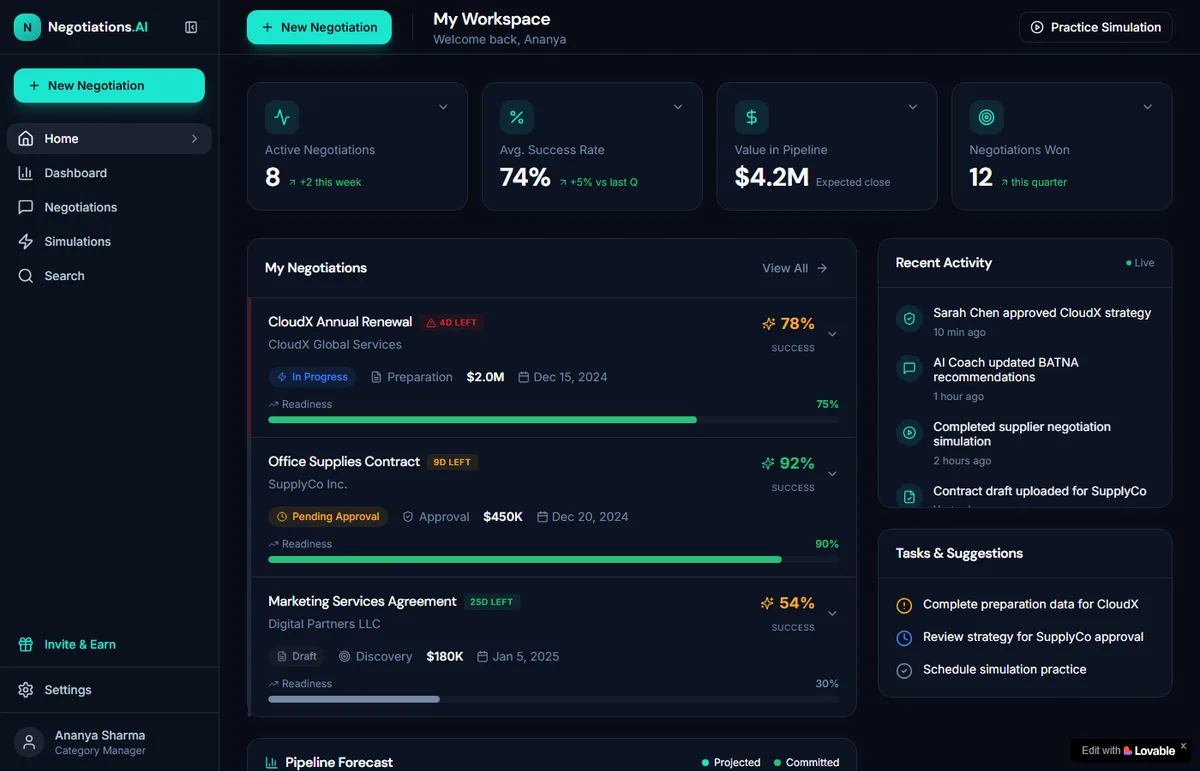
Negotiations.AI portfolio workspace with active negotiations, readiness, value pipeline, and tasks

Portfolio workspace

Explore the AI procurement workspace

1Prioritize where intervention matters
2Standardize decision quality
3Preserve learning across the team
What you leave with

A procurement strategy teams can execute deal by deal

Translate enterprise goals into category choices, supplier actions, negotiation plays, governance, and measurable learning.

A strategy allocates attention—not just spend

Procurement cannot apply the same process intensity to every purchase. Strategy determines where deeper evidence, market engagement, negotiation, resilience, innovation, governance, or automation will produce meaningful value. It also makes trade-offs explicit when cost, speed, risk, sustainability, and service pull in different directions.
Business-connected

Start with enterprise demand, operating priorities, risk appetite, growth plans, and stakeholder outcomes rather than procurement activity alone.

Portfolio-based

Segment categories and suppliers by value, risk, complexity, market dynamics, and the decisions that deserve scarce expertise.

Execution-owned

Translate priorities into named initiatives, decision rights, capabilities, data requirements, timelines, and outcome measures.

What is a procurement strategy?

A procurement strategy defines how an organization will use demand, supply markets, suppliers, commercial agreements, processes, people, data, and technology to deliver business outcomes. It establishes priorities and resource choices across the procurement portfolio, then translates them into category, sourcing, negotiation, contracting, and supplier-management actions.

Inside Negotiations.AI

See AI procurement strategy at portfolio and deal level

Leaders can see readiness and activity across negotiations while teams work from the same evidence-led method.

Ground outputs in deal context and evidence
Keep humans responsible for review and approval
Carry learning into the next negotiation round
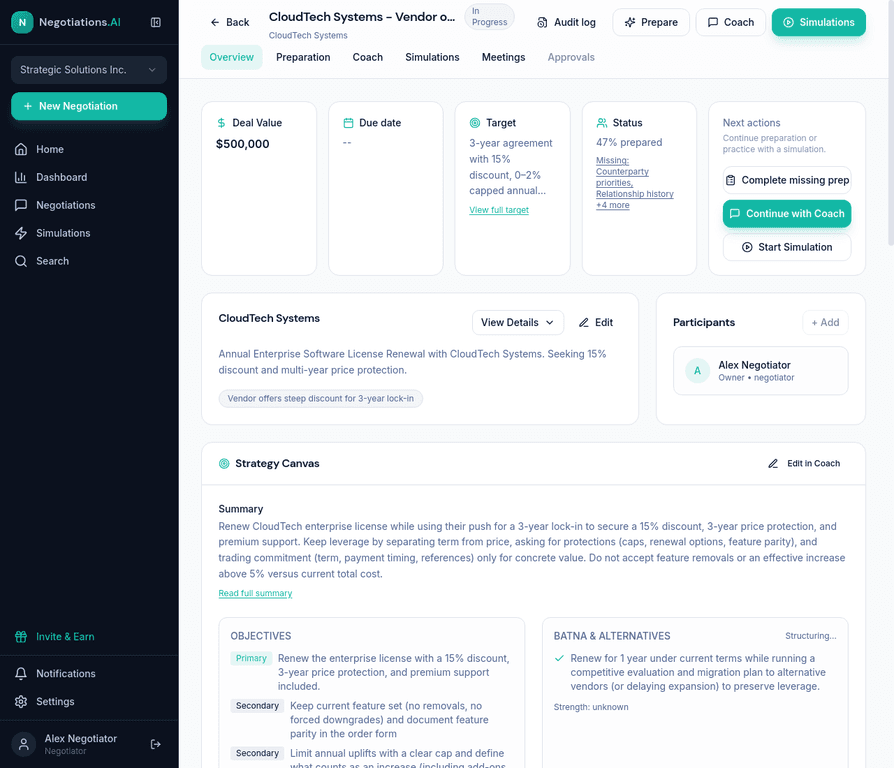
Negotiations.AI supplier negotiation strategy connected to procurement objectives and approvals

Deal-level execution

See the procurement copilot in action

Enterprise priorities become concrete targets, guardrails, and response paths for each supplier conversation.

Product output

Strategic demand intake

Connect business demand, stakeholders, timing, specifications, constraints, and risk to the procurement portfolio.

Product output

Portfolio evidence

Combine spend, demand, contracts, supplier performance, market signals, risk, and operational capacity.

Product output

Strategic initiative map

Prioritize sourcing, negotiation, demand, supplier, process, data, and technology plays with accountable owners.

Product output

Value and learning loop

Track commercial outcomes, adoption, risk, supplier behavior, assumptions, and reusable lessons across the portfolio.

Operationalize the strategy

How to build an executable procurement strategy

Move from enterprise outcomes to portfolio choices, then connect those choices to owned initiatives and measurable commercial results.

  1. 01

    Define business outcomes

    Clarify growth, margin, resilience, cash, innovation, sustainability, service, compliance, and stakeholder priorities.

  2. 02

    Diagnose the portfolio

    Analyze spend, demand, categories, contracts, suppliers, risk, markets, performance, maturity, capacity, and value leakage.

  3. 03

    Choose strategic plays

    Select demand, sourcing, negotiation, specification, supplier, risk, process, data, and technology interventions by segment.

  4. 04

    Design the operating model

    Assign ownership, decision rights, business partnering, governance, skills, data, systems, service levels, and escalation.

  5. 05

    Run and learn

    Sequence initiatives, measure outcomes and adoption, review assumptions, capture negotiation learning, and reallocate effort.

Use it when

Strategic choices procurement should make explicit

A useful strategy explains where procurement will intervene differently—and why those choices matter to the business.

Margin and cost transformation

Separate sustainable value from one-time savings and coordinate demand, specification, sourcing, negotiation, and supplier actions.

Supply resilience

Prioritize dependencies, qualification, capacity, inventory, contractual protection, alternatives, monitoring, and response authority.

Growth and innovation

Engage suppliers and markets where external capability, speed, technology, or collaboration can improve business outcomes.

AI-enabled procurement

Choose bounded use cases, connect trusted data, preserve human accountability, measure decision quality, and scale under governance.

Ground the recommendation

Evidence a procurement strategy should integrate

Portfolio choices should connect internal demand and economics to external supply markets, supplier reality, and the organization's capacity to execute.

Business demand

Forecasts, requirements, budgets, growth, operating constraints, service needs, specifications, and stakeholder priorities.

Commercial baseline

Spend, total cost, price, volume, contracts, payment, consumption, value leakage, savings history, and pipeline.

Supply landscape

Markets, capacity, cost drivers, competition, supplier performance, concentration, alternatives, innovation, and risk.

Execution capability

People, skills, capacity, processes, data, systems, governance, business adoption, decision rights, and change readiness.

Choose deliberately

Procurement strategies operate at several levels

Each level should answer a different question while remaining connected to the same business outcomes and evidence.

ApproachPrimary jobHuman roleBest fit
Enterprise procurement strategySet portfolio priorities, capabilities, operating model, and value agendaChoose trade-offs and allocate organizational attentionMulti-year functional direction and transformation
Category strategyShape demand and supply-market choices for a spend categoryIntegrate stakeholder needs, market evidence, and supplier optionsCategory-level value, resilience, innovation, and risk
Sourcing strategyChoose how to approach a specific market and supplier decisionDesign requirements, competition, evaluation, and negotiationA defined sourcing initiative or supplier-selection decision
Negotiation strategyChoose how to create and exchange value with counterpartiesOwn ranges, leverage, relationships, authority, and commitmentsA specific commercial negotiation or renewal

How the framework keeps strategy executable

The model links each strategic priority to a documented diagnosis, chosen commercial play, accountable owner, required capability, decision right, measure, and review cycle. This prevents broad ambitions from becoming disconnected project lists.

Keep exploring

Related guides and product paths

Use the next most relevant resource instead of starting another search from scratch.

Common questions

Procurement Strategy FAQ

What is a procurement strategy?+

A procurement strategy is the set of portfolio choices that determines how an organization will use demand, suppliers, markets, agreements, people, processes, data, and technology to deliver business outcomes such as value, resilience, speed, innovation, sustainability, and control.

What should a procurement strategy include?+

Include business outcomes, portfolio diagnosis, category and supplier segmentation, strategic plays, operating model, capabilities, data and technology priorities, governance, initiatives, owners, measures, dependencies, and review cycles.

How is procurement strategy different from sourcing strategy?+

Procurement strategy sets priorities and capabilities across the broader function and portfolio. Sourcing strategy defines how to approach a particular market and supplier decision, including requirements, competition, evaluation, negotiation, transition, and governance.

Where does AI fit in procurement strategy?+

AI can improve analysis, research, preparation, workflow, and decision support. Strategy should choose use cases based on evidence availability, decision consequence, measurable value, workflow adoption, security, governance, and the point where human approval remains necessary.

Bring one real negotiation

Make procurement strategy visible in daily decisions.

Connect portfolio priorities, category plans, supplier negotiations, and organizational learning in one workflow.